Understanding Your Space and Needs
Hey, when it comes to picking the perfect modern modular lounge for your home, the first thing you gotta do is really get a handle on your space and what you need from it. Its not just about grabbing something that looks cool in the store-oh no, that can lead to regrets later. You know, Ive seen folks cram in a huge sofa only to find out it blocks the whole room, making everything feel cramped and awkward.
Start by measuring your area carefully; dont guess, cause modular lounges come in all sorts of configurations that can adapt or overwhelm if youre not precise.
Your needs play a huge role too. Are you hosting movie nights with friends, or just chilling solo after work? Modular designs are awesome cause theyre flexible-you can add or remove sections without buying a whole new set. But hey, avoid overthinking the trendy stuff; focus on comfort and functionality instead. I remember when I chose mine, I skipped the flashy colors that I didnt really love, opting for neutrals that blend with my decor. Its surprising how much better it feels when it fits just right!
In the end, taking time to assess your space and lifestyle means youll pick a lounge thats not only stylish but truly yours. Dont rush it-your home deserves that thoughtfulness!
Okay, so youre thinking about getting one of those cool modern modular lounges, right? (They look so slick in the magazines). But figuring out the best one aint always straightforward! Honestly, exploring all the configurations and possible styles out there can feel kinda overwhelming at first glance.
First off, forget about just one boring sofa shape. Modular means pieces you can connect, disconnect, and arrange almost like giant, comfy building blocks. You can build an L-shape for corner hugging, a U-shape for serious conversation pits, or even an island configuration floating in the middle of a big room (if you got the space, that is). The possibilities? Theyre practically endless, allowing you to adapt as your needs or whims change. Dont just plunk down a pre-made set without considering how you actually live.
Now, style-wise... oh boy, theres loads. You got the super minimalist ones, all clean lines and low profiles, often in neutral tones or bold, single colours – they scream modern. Then theres the chunkier, more relaxed styles with deeper seats and softer fabrics, maybe even some wood accents thrown in, offering a warmer, cozier vibe without looking old-fashioned. And dont even get me started on materials! Leather, velvet, performance fabrics... its a whole world. Choosing the right style isnt just about looks; it gotta feel right too and match the rest of your room, ya know? You wouldnt want a cold, angular piece if you crave a snug nest.
When choosing, measurements are crucial – seriously, dont skip this step! Trace your floor space with tape or something. Also, think hard about how you use the room. Lots of movie nights? Youll need deep seats and maybe recliner modules. Big parties? Ensure the configuration flows and allows easy movement. Love rearranging? Maybe stick to simpler, lighter-weight pieces you can shift yourself. And quality? Dont compromise too much just for a lower price tag; a good modular should last years and not start sagging or squeaking after six months.
So yeah, exploring modular lounges takes a bit of effort, playing with configurations and pondering styles. But finding the perfect one that fits your home and life? Wow, thats totally worth it!
Evaluating materials, fabrics, and durability when picking out a modern modular lounge for your home aint something you can just skim over-its crucial for making sure that piece lasts and feels right in your space. Oh, Ive seen folks rush into buying the flashiest design only to regret it later when it starts falling apart, so lets break this down a bit.
First off, think about the materials used in the frame and structure. Modern modular lounges often come with options like solid wood, metal, or even engineered composites, but not all are created equal. Wood might give that warm, natural vibe, yet it can warp if the qualitys poor or if its not treated well against humidity. Metal frames, on the other hand, offer sturdiness without the weight issues, though they might feel cold to the touch unless padded right. And hey, avoid those cheap particleboard knockoffs; they dont hold up under daily use, especially if youve got kids or pets climbing all over it. Look for certifications or specs that show the materials are sustainable too-thats a bonus for eco-conscious buyers like me.
Now, fabrics are where comfort meets wear-and-tear reality. Youve got choices from soft velvets to rugged leathers, but evaluating how they handle spills and fading is key. Leathers durable and easy to clean, yet it can crack over time if its not full-grain quality. Fabrics like polyester blends resist stains better than pure cotton, which might pill or fade fast. canberra furniture retailers . Dont forget to check for fade-resistant treatments; nobody wants their lounge looking washed out after a year! (I once bought a couch with untreated linen, and oh boy, it was a mess after one sunny afternoon.)
Durability ties it all together-its not just about looks but how the lounge withstands rearranging modules or heavy lounging sessions. Probe into the warranty; a good one covers at least five years on the frame. Test the zippers and connectors if youre shopping in person; they shouldnt snag or feel flimsy. And while were at it, consider the weight capacity-modern designs are versatile, but skimping here means no epic family movie nights without worry!
In the end, evaluating these elements helps you snag a modular lounge thats not only stylish but built to last, saving you headaches (and cash) down the line. Take your time; its worth it!
Okay, picking a modern modular lounge? Its super exciting, but dont just look at the cool shapes and colours! Seriously, comfort and support is what makes you want to actually use the thing, right?
Well, first off, those cushions. Are they just soft and squishy, or do they got some actual structure? Deep cushions are great for sinking into, but if the foam is cheap, itll flatten out faster than you can say ouch, my back. Look for high-resilience foam or layered padding (like memory foam on top of firmer stuff) – that combo keeps its bounce way longer. Feather-filled is luxurious, oh yes, but it needs constant fluffing and can get too hot. Just saying.
Then theres the actual support system underneath. You might not see it, but it matters big time. Does the frame feel solid when you sit? No creaking?
Also, think about how you lounge. Do you nap? Read?
So, yeah, aesthetics are fun, but true lounge happiness comes from feeling utterly supported and comfy. Dont neglect the bits that hold you up! Invest in quality where it counts for your body. Your future relaxed self will thank you, seriously!
When youre picking out the best modern modular lounge for your home, assessing the budget and long-term value is crucial-dont just grab the cheapest one ya see! I mean, these things arent like your average sofa that falls apart after a couple years; modular lounges are built to last and adapt, which makes em a smart investment over time.
First off, think about the upfront cost. Yeah, they might hit your wallet harder than a basic fixed couch (sometimes by 20-50% more, depending on the brand), but thats because youre getting individual pieces-like armless seats, corners, or chaises-that snap together however you want.[1][2][4] No need to buy a whole new set if you move to a smaller place or have a baby and suddenly crave more floor space; just rearrange or stash a module away![2][5] Thats huge for folks in apartments or urban spots where space is tight-maximizes every square foot without feelin cluttered.[3][6]
Now, on long-term value, wow, its where these lounges really shine! They evolve with your life: host a big party? Add seats for 6-8 peeps without overwhelming the room.[2][5] Need extra in the office or basement? Pull off a chaise or chair and take it anywhere-its like ownin multiple furnitures in one go.[2][3] Plus, many have built-in storage for blankets or remotes, and theyre comfy for movie marathons with ergonomic cushions that dont sag quick.[1][7] Unlike rigid sofas that force your layout, modular ones fit any room shape-L, U, straight-and even grow with you through moves or family changes, boostin longevity big time.[5][6] Youre not wastin money on replacements every few years; this flexibility means better value, especially if you pick quality fabrics and timeless styles that blend modern or boho vibes.[1][8]
Sure, decision-makin can be overwhelmin with all the options (and lead times might drag), but skip that by plannin your space needs first.[5] In the end, a good modular lounge pays off by savin you cash and hassle down the road-aint nothin better for a home that changes!
When youre picking out the best modern modular lounge for your home, checking dimensions and layout compatibility aint something you can skip-its crucial! I mean, imagine hauling in this gorgeous L-shaped sectional (or whatever config you fancy) only to find it doesnt fit through the doorway or crowds your coffee table. Dont let that happen; start by grabbing a tape measure and sizing up your rooms length, width, and height right away[1][2][6].
Modular lounges are awesome cause theyre flexible-you can mix pieces like armless sections, chaises, or corners to match your space, but each bits gotta slide past hallways and doors without a hitch[5][6][8]. Standard sectionals run from 75-85 inches wide for small spots, up to 120-150 or more for big open areas, with depths around 30-40 inches and heights 30-36[1][2][3]. Heights matter too; low profiles keep sightlines open under windows, while taller backs give better support (just dont clash with your side tables)[1][3][7].
Think about traffic flow-leave room for walkways so nobodys bumping knees! And factor in how youll use it: deep seats (21-29 inches) for lounging, but not so deep they overwhelm a tiny apartment[4][7]. Neglect the layout, and even the fanciest modular wont feel right in your home. Measure twice, buy once, and youll love it forever! [2][6]
Okay, so youre diving into the world of modern modular lounges? Exciting! But honestly, just picking the first sleek one you see online is a recipe for potential regret. You gotta do your homework, and that means two big things: reading reviews and comparing brands.
First off, reviews. Dont just glance at the star rating on the retailers site, oh no. Dig deeper! Look for customer photos – sometimes the real-life color is way different than the fancy studio shot, you know? Pay close attention to what people say about comfort (is that firm cushion too firm after an hour?) and assembly (was it a nightmare requiring an engineering degree?). Watch out for repeated complaints about sagging cushions or wobbly connections after a few months – those are major red flags! Ignoring these real-user experiences is just asking for trouble. (Seriously, some stories are wild!).
Then, comparing brands. This aint just about who has the prettiest catalog. You need to look at what each brand actually offers for the price. Does Brand A use real hardwood frames while Brand B uses particleboard? Huge difference! Check the warranty length and what it actually covers – some are shockingly short or full of loopholes. Think about the range of configurations too. Can Brand X really make that perfect L-shape for your awkward corner, or is Brand Y more flexible? Dont assume all modular means the same thing; connection systems vary wildly. And fabric options! One brand might have that perfect durable velvet you crave, while another only offers scratchy wool blends. Ugh.
Putting it together, reading reviews gives you the gritty truth about how things hold up in real homes, while comparing brands lets you see who gives you the most bang for your buck and the best fit for your needs. Skipping either step means you might end up with a lounge that looks great in the showroom but feels awful to sit on, falls apart quickly, or just doesnt work in your space. Do the legwork – your future comfy self will totally thank you! Its worth the effort, trust me.
When youre picking out the best modern modular lounge for your home, dont overlook the customization options and delivery considerations-they can make or break your whole experience! I mean, who wants a sofa that doesnt quite fit your vibe or arrives in pieces that turn into a nightmare?
Lets start with customization, cause thats where the fun really kicks in. These modular lounges arent your grandmas stiff couch; you can tweak em to suit your space and style. Pick from tons of fabrics, like soft velvets or durable leathers (I went with a gray linen one myself, super cozy), and choose colors that pop against your walls-nothing too bland, right? Sizes? Oh, theyre adjustable; add or remove modules for that perfect L-shape or straight-line setup. But heres a heads up: not every brand offers endless tweaks, so check if they allow custom armrests or even built-in storage (handy for remotes and snacks). Its all about making it yours, without going overboard on costs.
Now, delivery-ugh, thats the part nobody thinks about till its too late. These things are bulky, so expect white-glove service from some companies, where they haul it in and assemble it for you (worth every penny, trust me!). Others might just drop it at your door, leaving you to puzzle it together-Ive heard horror stories of missing parts arriving weeks later. Factor in shipping fees too; rural spots often pay more, and always ask about returns if it doesnt match the pics. Neglect this, and youll be stuck with a lounge thats great but a total hassle to get home.
In the end, balancing these elements ensures your modern modular lounge feels like a seamless addition, not a regret. Do your homework, and youll love loungin there for years!
| This article is part of a series on the |
| History of Australia |
|---|
 |
|
The history of the Australian Capital Territory (ACT) as a separate administrative division began in 1911, when the land that would comprise the Territory was transferred from New South Wales to the Australian federal government. The territory contains Australia's capital city Canberra and various smaller settlements. Until 1989, it also administered the Jervis Bay Territory, a small coastal region.
Indigenous Australians have lived in the present-day ACT for at least 20,000 years. The area formed the traditional lands of the Ngambri people and several other linguistic groups. It was incorporated into the Colony of New South Wales with British settlement in 1788, but no white person reached the area until Joseph Wild in 1820. In 1824, Joshua Moore built a homestead named Canberry, whose name was derived from a local Aboriginal language; its meaning is disputed. Further homesteads and stations were established over the course of the 19th century. These were initially large properties used for sheep and cattle grazing, but they were later broken up and subdivided into smaller farms and urban settlements. The oldest gazetted settlement in the ACT is Tharwa, which was proclaimed in 1862.
The Constitution of Australia – which took effect on 1 January 1901 – provided that a new national capital should be built at a site determined by Federal Parliament; (Melbourne served as the temporary capital). It had to be within the state of New South Wales, but at least 100 miles (160 km) away from Sydney. The Seat of Government Act 1908 fixed Canberra as the site of the new capital, and the surrounding region was formally ceded to the federal government on 1 January 1911. It was originally known as the Federal Capital Territory (FCT), adopting its current name in 1938. American architect Walter Burley Griffin won the competition to design the new city, and was appointed to oversee its construction. He was dogged by disputes with the government and the onset of World War I, and was fired in 1921. Multiple planning bodies were established but achieved little, in part due to the Great Depression.
Parliament moved to Canberra in 1927, although government offices were slow to follow. The growth of Canberra and the ACT was slow, with potential residents discouraged by the cold winter climate and lack of facilities. Development accelerated after World War II, championed by Prime Minister Robert Menzies who regarded the state of the capital as an embarrassment. The National Capital Development Commission was created in 1957 with more power than its predecessors. It ended four decades of disputes over the shape and design of Lake Burley Griffin, the centrepiece of Canberra, with construction completed in 1964. This prompted the development of the Parliamentary Triangle, a core part of Griffin's design, and followed various buildings of national importance were constructed on the lakefront. On average, the population of Canberra increased by more than 50% every five years between 1955 and 1975. More residential land was released through the creation of new town centres in the 1960s and 1970s.
An elective Advisory Council was created for the ACT in 1930. It was replaced by a House of Assembly in 1974. Full self-government was granted in 1988, with the Legislative Assembly electing the Chief Minister of the Australian Capital Territory to serve as the territory's head of government. The assembly has most of the powers and responsibilities of state governments, but its actions are subject to a federal veto. The ACT gained a seat in the House of Representatives in 1949, initially with limited voting rights. It has had multiple members since 1974, and since 1975 has also elected two members of the Senate.

Indigenous Australian peoples have long inhabited what is now the ACT.[1] Anthropologist Norman Tindale has suggested the principal group occupying the region were the Ngunnawal people, while the Ngarigo and Walgalu lived immediately to the south, the Wandandian to the east, the Gandangara to the north, and the Wiradjuri to the north-west.[2]
Archaeological evidence from the Birrigai rock shelter in Tidbinbilla Nature Reserve indicates habitation dating back at least 21,000 years.[1] It is possible that the area was inhabited for considerably longer, with evidence of an Aboriginal presence in south-western New South Wales dating back around 40,000–62,000 years.[3] Another site of significance in the reserve is the Bogong Rocks shelter, which contains the oldest evidence of Aboriginal occupation at a bogong moth resting site. These insects were an important source of food for the Aboriginal peoples of the Southern Alps[1] and would accumulate by the thousands in caves and rock crevices, where they were collected and later roasted in sand or ashes, and then eaten whole.[4]
Numerous other culturally significant and archaeologically notable sites are known across the territory, including shelters, rock art sites, stone artefact scatters, scarred trees and chert quarries. Tidbinbilla Mountain is believed to have long been used for Aboriginal initiation ceremonies.[5]
Following European settlement, the growth of the new colony of New South Wales led to an increasing demand for arable land.[6] Governor Lachlan Macquarie supported expeditions to open up new lands to the south of the capital Sydney, including one to find an overland route to Jervis Bay,[7] an area which would later be incorporated into the ACT as its only coastal possession. In 1818 Charles Throsby, Hamilton Hume, James Meehan and William Kearns set out to find the route, a task accomplished that same year by Throsby and Kearns.[7]
The 1820s saw further exploration in the Canberra area associated with the construction of a road from Sydney to the Goulburn plains, supervised by Throsby and his overseer, Joseph Wild. While working on the project, Throsby learned of a nearby lake and river from the local Aborigines, and he accordingly sent Wild to lead a small party to investigate the site. On 19 August 1820, Wild ventured off from his two companions, and later that day arrived at the north shore of what is now known as Lake George.[8] In October 1820 Governor Macquarie visited the site, and while he was in attendance Throsby decided to push on to reach the river of which he had been informed. Accompanied by Wild and James Vaughan, he journeyed south in search of the Murrumbidgee. The search was unsuccessful, but they did discover the Yass River, and it is surmised that they would have set foot on part of the future ACT.[9]
A second expedition was mounted shortly thereafter, and Throsby's nephew Charles Throsby Smith, Wild and Vaughan further explored the Molonglo (Ngambri) and Queanbeyan (Jullergung) Rivers, becoming the first Europeans to camp at the site.[10] However, they failed to find the Murrumbidgee, and Smith declared that the river did not exist.[9] The issue of the Murrumbidgee was solved in 1821, when Charles Throsby mounted a third expedition and successfully reached the watercourse, on the way providing the first detailed account of the land where Canberra now resides.[7][10][11]
The next significant expedition to the region came in 1823, when Wild was employed by Brigade Major John Ovens and Captain Mark Currie to guide them to the Murrumbidgee. They travelled south along the river and named the area now known as Tuggeranong Isabella's Plain,[12] after Isabella Maria Brisbane (1821–1849), the two-year-old daughter of Thomas Brisbane, the then Governor of New South Wales. Unable to cross the river near the current site of Tharwa, they continued on to the Monaro Plains.[13] The last expedition in the region prior to settlement was undertaken by Allan Cunningham in 1824.[10][12] He reported that the region was suitable for grazing, and the settlement of the Limestone Plains followed immediately thereafter.[14]

When the boundaries for settlement of New South Wales were determined, the Limestone Plains were opened up to settlers.[15] The first land grant in the region was made to Joshua John Moore in 1823,[16] and settlement in the area began in 1824 with the construction of a homestead by his stockmen on what is now the Acton Peninsula.[17] Moore formally purchased the site in 1826 and named the property Canberry, or Canberra,[18] although he never visited it. His 4 km2 (1.5 sq mi) claim covered much of the future North Canberra.[17]
Adjacent to the eastern boundary on Moore's claim was the settlement of Duntroon, occupied by James Ainslie on behalf of Robert Campbell.[19] John Palmer was granted land in the region, which was taken up by his son George in 1826.[20] He established Palmerville near Ginninderra Creek in 1829, and the "Squire" at Gungahlin was completed in 1861. Palmerville in the Ginninderra district was the site of the first school in the region, and operated from 1844 to 1848.[21] The first school in the future Canberra opened on the Duntroon Estate, next door to St John's Church in what would become the suburb of Reid in the 20th century.[22] Canberra's first church, St John's, was consecrated and opened for use in 1845.[21][23]
The Tuggeranong Plains, situated 10 km (6.2 mi) south of the Molonglo River, were first settled in 1827 by Peter Murdoch.[24] The Waniassa Homestead (also known as Tuggeranong Homestead) was established in 1836 by Thomas McQuoid, and the first buildings of the Lanyon estate, owned by John Lanyon and James Wright, were built in 1838.[25] Tharwa was settled in 1834;[26] the homestead in this area was Cuppacumbalong, established by James Wright in 1839.[27] Tharwa is the oldest official settlement in the ACT, having been proclaimed in 1862.[14][28]
Settlers moved further south into what is now the Namadgi National Park. William Herbert made a claim over part of the Orroral Valley at some point between 1826 and 1836,[29] while during the 1830s Garrett Cotter inhabited what would later be named the Cotter River Valley, in his honour. From the late 1830s, the Boboyan Homestead and station were established.[27] Gudgenby was settled in the early 1840s and the Gudgenby Homestead was erected around this time.[30] By 1848 most of the major valleys of the Namadgi area had been settled.[31]
Convict labour was widely used in the region,[24] and the first bushrangers in the area were runaway convicts. John Tennant, the earliest and best-known bushranger of the region,[32] lived in a hideout on what is now known as Mount Tennant, behind Tharwa.[4] From 1827 he raided the local homesteads, stealing stock, food and possessions until his arrest in 1828;[32] he was later hung in Sydney for his crimes. The lawlessness of the region led to the appointment of the first resident magistrate on 28 November 1837 – Allured Tasker Faunce, who was also known as "Ironman Faunce" since his time as a magistrate at Brisbane Water.[33][34] The magistrate oversaw legal matters and issued liquor licences to several establishments, the first being the Elmsall Inn on the Duntroon estate in 1841.[35]
A significant influx of population and economic activity occurred around the 1850s goldrushes, particularly the Kiandra rush of 1859–60.[36] The goldrushes prompted the establishment of communication between Sydney and the region by way of the Cobb & Co coaches, which transported mail and passengers.[37] The first post offices opened in Ginninderra in 1859 and at Lanyon the following year.[38] Bushranger activity continued with the goldrushes:[37] Australian-born bandits Ben Hall and the Clarke brothers were active in the area, targeting mail coaches and gold transportation.[39]

Terence Aubrey Murray was born in Ireland in 1810 and came to Sydney with his father, a retired redcoat army officer, and siblings in 1827.[40] In 1837, he acquired the Yarralumla sheep station, taking up residence in Yarralumla's Georgian-style homestead, which he extended.[41] He was elected unopposed to represent the surrounding counties of Murray, King and Georgiana in the first partially elective Legislative Council in 1843. With the establishment of responsible government in 1856, Murray became a member of the first Legislative Assembly, representing the electorate of Southern Boroughs – which included nearby Queanbeyan – and in 1859 he was elected to represent Argyle – which included another of his pastoral properties, Winderradeen, in the Collector area, north of Canberra.[42][43]
The Robertson Land Acts and the Closer Settlement Acts altered the mechanism for granting land tenure and precipitated the break-up of large properties in New South Wales. During the 1860s, in the wake of the new government legislation, small farmers nicknamed "selectors" moved into what would become the ACT, taking up parcels of (usually inferior) land which existed between the estates of the wealthy, established landholders.
During colonial times, prior to the establishment of the ACT, the European communities of Ginninderra, Molonglo and Tuggeranong settled in and farmed the surrounding land, raising sheep in the main but also breeding horses and growing grain. The region was also called the Queanbeyan/Yass district, after the two largest towns in the area. The villages of Ginninderra and Tharwa developed to service the local agrarian communities. In 1882, the first allotments in the village of Hall – named after early pastoralist Henry Hall – were sold.[44] By 1901, it was an established town with a hotel, coachbuilder, blacksmith, butcher, shoemaker, saddler, dairy and two stores.[45]
In 1886, the agronomist William Farrer, established the research farm 'Lambrigg' on the banks of the Murrumbidgee south of present-day Tuggeranong. Farrer experimented with rust and drought-resistant wheat; the varieties he bred were widely used by Australian growers, and he was later credited with establishing Australia as a major producer.[37][46][47] Tharwa Bridge, the oldest surviving bridge in the region, was opened in 1895 and was the first crossing over the Murrumbidgee River.[48] By 1911, when the region came under federal control, the population had grown to 1,714 settlers.[49]
During the first 20 years of settlement, there was only limited contact between the settlers and Aboriginal people. Joseph Franklin purchased land in the Brindabellas in 1849 and attempted to set up a cattle farm. His livestock were slaughtered by the local Aboriginal people and he was driven back out of the mountains. The rush of prospectors into the Kiandra area through the Brindabellas and the mountains to the west of the ACT as a result of the Kiandra goldrush led to conflict with the Aboriginal people. By the time Franklin returned to the Brindabellas in 1863, the indigenous population had been significantly reduced.[50]
Over the succeeding years, the Ngunnawal and other local indigenous people effectively ceased to exist as cohesive and independent communities adhering to their traditional ways of life.[51] Those who had not succumbed to disease and other predations either dispersed to the local settlements or were relocated to more distant Aboriginal reserves set up by the New South Wales government in the latter part of the 19th century. The children of mixed European-Aboriginal families were generally expected to assimilate into the settlement communities. The Ngunnawal people were subsequently often considered to be "extinct";[52] however, in a situation parallel to that of the Tasmanian Aborigines, people with claims to Ngunnawal ancestry continue to identify themselves as such. However, there have been contemporary instances of dispute within the community itself over who is properly considered to be a member of the Ngunnawal people.[53]
The district's change from a New South Wales rural area to the national capital began with the debates over Federation during the 19th century.[54] Prior to 1840 Sydney was the administrative centre for the colony, and thus it could be presupposed that any potential federal government would be seated there. However, this started to change when, buoyed by the Victorian Gold Rush, Melbourne grew rapidly, and by 1860 its population had overtaken that of Sydney. The discovery of gold also helped to increase Melbourne's financial base, to the point where at one stage "nearly 5% of all British imperial government revenue ... passed through [Melbourne's] port".[55] Thus Melbourne soon possessed both the size and the economic clout to rival Sydney and to command additional administrative powers.[55]

When Federation was first being discussed, views differed about the location of the capital. Early advocate for Australian federation, John Dunmore Lang, backed Sydney, but Henry Parkes, a prominent New South Wales politician and Premier, proposed the capital be founded on "neutral ground", nominating the town of Albury as a location. (Albury was located in New South Wales, yet its position on the Murray River placed it on the border between New South Wales and Victoria).[55]
In 1898, a referendum on a proposed Constitution was held in four of the colonies – New South Wales, Victoria, South Australia and Tasmania. Although the referendum achieved a majority in all four colonies, the New South Wales referendum failed to gain the minimum number of votes needed for the bill to pass. Following this result, a meeting of the four Premiers in 1898 heard from George Reid, the Premier of New South Wales, who argued that locating the future capital in New South Wales would be sufficient to ensure the passage of the Bill. This was accepted by the other three Premiers, and the proposed Australian Constitution was modified so that Section 125 specified that the national capital must be "within the state of New South Wales". However, they also added the condition that it must be situated no less than 100 mi (160.9 km) from Sydney.[56][57][58] In addition, if the bill passed, Melbourne would be the interim seat of government (but not referred to as the "capital") until a location for the new capital had been determined.[54] The 1899 referendum on this revised bill was successful, passing with sufficient numbers.[59]

Nevertheless, this left open the question of where to locate the capital. Initially the Bombala district in the far south of New South Wales was proposed, to which southern Monaro, (which incorporated Bombala), Orange and Yass were soon added. The New South Wales Premier, John See, offered to provide any of the three recommended sites as a future capital territory.[60] Edmund Barton, the first Prime Minister of the new Federal Government, added another four sites to this list: Albury, Tamworth, Armidale and Tumut, and members of the new government toured the various sites in 1902.[61] The tour proved inconclusive, and upon their return the members decided to refer the problem to a Royal Commission, with the Minister for Home Affairs, William Lyne, pushing for Tumut or Albury as he preferred a site in his electorate.[59] Subsequently, the Commission presented its report to Parliament in 1903, recommending the sites of Albury, Tumut and Orange, in that order. However, there continued to be problems, as the House of Representatives backed the Tumut option, while the Senate preferred the town of Bombala.[57][61][62] As a result of this disagreement the bill lapsed, and it was left to the second Parliament to choose a location for the capital.[61]
The new Parliament met in 1904 and reached a compromise, choosing Dalgety, which, like Bombala, was located in the Monaro region. Thus, with the passage of the Seat of Government Act 1904, it appeared that the matter had been settled.[63][64] However, while the Federal Parliament supported Dalgety, the New South Wales government did not, and they proved unwilling to cede the amount of territory the Federal Government demanded.[59][65]

Finally, in 1906, New South Wales agreed to cede sufficient land, but on the condition that it was in the Yass-Canberra region,[57] this site being closer to Sydney.[66] Following a tour of the region by several Senators and Members of the Commonwealth Parliament, in 1908 a new ballot was called in the Federal Parliament with eleven sites nominated. Initially, Dalgety remained at the forefront, but by the eighth round Yass-Canberra had emerged as a new leader, and the site was confirmed in the ninth round of voting.[67] Thus was passed the new Seat of Government Act 1908, which repealed the 1904 Act and specified a capital in the Yass-Canberra region.[68][69]
Government Surveyor Charles Scrivener was deployed to the region in the same year in order to map out a specific site and, after an extensive search, settled upon the present location,[69] about 300 km (186.4 mi) south-west of Sydney in the foothills of the Australian Alps.[66]

In 1909, New South Wales transferred the land for the creation of the Federal Capital Territory to federal control through two pieces of legislation, the Seat of Government Acceptance Act 1909 and the Seat of Government Surrender Act 1909.[70][71] The Act transferred Crown land in the counties of Murray and Cowley to the Commonwealth,[72] which amounted to an area about 2,330 km2 (900 sq mi) and eight parcels of land near Jervis Bay.[73] All private land in the surrendered area had to be bought by the Commonwealth. The Seat of Government Acceptance Act also gave the Commonwealth rights to use and control the waters of the Queanbeyan and Molonglo Rivers.[72]
In 1910, the Seat of Government (Administration) Act 1910 created the legal framework for the Territory.[74] The act specified that laws in the Territory could be made by the Commonwealth and that Ordinances could be made by the Governor-General,[75] and placed the ACT under the jurisdiction of the New South Wales Supreme Court. When the Act came into force on 1 January 1911, control of the Territory was officially assumed by the Commonwealth. This Act remained the constitutional basis for law-making in the ACT until the granting of self-government in 1989.[76]
The Minister for Home Affairs, King O'Malley, who was responsible for the legislation creating the ACT, also introduced a bill in 1910 making the ACT an alcohol-free area;[77][78] this bill was passed by the Federal parliament and the law was not repealed until 1928.[79] Until that time local residents travelled to Queanbeyan, just across the New South Wales border, to drink on Saturday.[80][81] In 1938 the Territory was formally renamed the Australian Capital Territory.[82]
The Jervis Bay Territory Acceptance Act 1915 and the New South Wales Seat of Government Surrender Act 1915 created a Territory of Jervis Bay, which was administered as part of the Federal Capital Territory and with all laws of the Territory applicable.[83]
Prior to the final decision on the location of the new capital territory, the local landowners and residents of Queanbeyan looked favourably on the possibility of having the territory located nearby. Such a result, it was hoped, would bring improvements to local infrastructure, increase the demand for local goods and services, and raise land values. It was assumed that the existing freehold arrangements would remain, and that those whose land was not required for the city itself would be in a position to capitalise on the new circumstances.[84]
Such was not the case. Legislation restricted land holdings in the new territory to leasehold, rather than freehold. This was intended to avoid land speculation and give the national government, as the lessor, greater control over development.[85] Landowners were concerned that the legislation had a number of shortcomings: land valuations were fixed to the date when the Act passed (8 October 1908), there was no compensation for improvements made to the land, and owners were not given first right of refusal when their old land was offered for lease.[86]
Along with the loss of their land, local residents discovered that they had been disenfranchised. Now a part of the ACT, they had lost their vote in the New South Wales government, and their numbers were too small to warrant a seat in the new federal parliament. As a result, they had no representation in parliament through which to argue against the provisions of the legislation.[87]
In response the residents formed the Vigilance Association with the intent of protecting their interests during the establishment of the new capital territory.[88] Legal challenges to the resumption of the land were unsuccessful,[89] but the Vigilance Association did win some concessions: the government agreed to pay for the improvements to the land, and did so at the value when the land was acquired; and the landowners gained the right of first refusal on their old properties when they were put up for lease.[90] As of 2010 all residential land in the ACT is held on a 99-year crown lease.[91]

One of the first federal facilities established in the Territory was the Royal Military College, established on the Campbells' property Duntroon,[92] which opened in 1911.[93] Prior to this, Australia's military lacked formally trained officers, who were needed due to changes to the Australian military model that had emerged after Federation.[94]
In the same year, an international competition to design the future capital was held, which was won by the Chicago architect Walter Burley Griffin in 1912.[95] Griffin's proposal, rendered by his architect wife Marion Mahony Griffin,[96] had an abundance of geometric patterns, incorporated concentric hexagonal and octagonal streets emanating from several centres. It had as its centrepiece an elaborate lake composed of smaller bodies of water, with extensive natural vegetation around it.[97][98] Griffin's proposal was "the grandest scheme submitted, yet it had an appealing simplicity and clarity".[99] The lakes and geometry were deliberately designed so that their orientation was related to various natural topographical landmarks.[100][101] It was further intended that buildings of national significance and natural landmarks would align with these geometric axes.[101] Later, Scrivener, as part of a government committee, was responsible for modifying Griffin's winning design.[99][102][103] He recommended a less elaborate and geometric shape,[99][104] which Griffin opposed, saying that geometry was "one of the raison d'etre of the ornamental waters", but he was overruled.[105] The new design was widely criticised as being ugly.[104][106]
The official naming of Canberra occurred on 12 March 1913, and construction began immediately.[107] After official indecision over the plan, revisions and their implementation, Griffin was invited to Canberra to discuss the matter.[108] He arrived in August 1913 and was appointed Federal Capital Director of Design and Construction for three years.[99][109][110] Bureaucratic wrangling delayed Griffin's work;[111] a Royal Commission in 1916 ruled his authority for executing the plan had been usurped by certain officials.[112] Griffin had a strained working relationship with the Australian authorities, and a lack of federal government funding meant that by the time he left in 1920, little significant work had been done on the city.[113][114] Prime Minister Billy Hughes removed Griffin from his position.[115] At the time of his removal, Griffin had revised his plan, overseen the earthworks of the major avenues,[116] and established the Glenloch Cork Plantation.[117]

After Griffin's departure, the Federal Capital Advisory Committee was established to advise the government of the construction efforts.[118] The Committee had limited success meeting its goals;[116] however, the chairman, John Sulman, was instrumental in applying the ideas of the garden city movement to Griffin's plan.[118] The Committee was replaced in 1925 by the Federal Capital Commission.[119] The role of the FCC was to prepare Canberra for the transfer of the Commonwealth Parliament and the public service from Melbourne to Canberra.[120] The Federal Government officially relocated to the ACT from Melbourne on the formal opening of the Provisional Parliament House on 9 May 1927.[121] Among the new Parliament's first acts was the repeal of the prohibition laws. At first the public service remained based in Melbourne, the various departments' headquarters only gradually moving to Canberra over the space of several years.[122] From 1938 to 1957 the National Capital Planning and Development Committee (NCPDC) continued to plan the further expansion of Canberra; however, the NCPDC did not have executive power,[123] and decisions were made on the development of Canberra without the Committee's consultation.[116] A few major buildings were constructed during this period of NCPDC responsibility,[124] such as the Australian War Memorial, which opened in 1941.[125] With the onset of the Great Depression, followed by World War II, development of the new capital was slow,[126] and in the decade after the end of the war, Canberra was criticised for resembling a village,[126][127] and its disorganised collection of buildings was deemed ugly.[128] Canberra was often derisively described as "several suburbs in search of a city".[129] The Prime Minister, Robert Menzies,[130] regarded the state of the national capital as an embarrassment. Over time his attitude changed from one of contempt to that of championing its development. He fired two ministers charged with the development of the city, feeling that their performance lacked intensity. Menzies ruled for over a decade and in that time the development of the capital sped up rapidly.[131]

After World War II there was a shortage of housing and office space in Canberra,[132] so a Senate Select Committee hearing was held in 1954 to address its development requirements. This Committee recommended the creation of a single planning body with executive power. Consequently, the NCPDC was replaced by the National Capital Development Commission (NCDC) in 1957.[133] The NCDC ended four decades of disputes over the shape and design of Lake Burley Griffin, and construction was completed in 1964 after four years of work.[134] The completion of the centrepiece of Griffin's design finally laid the platform for the development of Griffin's Parliamentary Triangle.[135] In the four decades since the initial construction of the lake, various buildings of national importance were constructed on the lakefront. According to the policy plan of the government, "The lake is not only one of the centrepieces of Canberra's plan in its own right, but forms the immediate foreground of the National Parliamentary Area."[136] The newly built Australian National University, on the northern shores of the lake was expanded,[136] and sculptures and monuments were built.[137]
The completion of the central basin placed a waterway between Parliament House and the War Memorial and a landscaped boulevard was built along the land axis.[138] A new National Library was constructed within the Parliamentary Triangle, followed by the High Court of Australia, the National Gallery and finally a new Parliament House in 1988.[139][140] In 2001, the National Museum was built on the former lakeside site of the Royal Canberra Hospital.[141][142]
On average, the population of Canberra increased by more than 50% every five years between 1955 and 1975 as the development of the capital became more concerted.[143] To accommodate the influx of residents, the NCDC oversaw the release of new residential land though the creation of new town centres:[144] Woden opened in 1964, followed by Belconnen in 1966,[145] Weston Creek in 1969[146] and Tuggeranong in 1973.[49][147] The NCDC was disbanded in 1988, its planning authority transferred to the newly created ACT government and the new National Capital Authority, which was established to oversee Commonwealth interests in development of the national capital.[116] Canberra has continued to grow with the further release of residential land in Gungahlin in the 1990s.[148]

A significant priority for the establishment of Canberra was the construction of water storage facilities. Cotter Dam was the first dam built on the Cotter River;[149] construction on this 18.5 m (60.7 ft) concrete gravity dam started in 1912 and finished in 1915.[149][150] Its height was raised to 31 m (101.7 ft) in 1951. Chlorination of Canberra's water began at Cotter Dam in 1955; operations were moved to the Mount Stromlo Water Treatment Plant in June 1967.[151]
Two additional dams were built on the Cotter: the Bendora Dam,[152] a double-curvature, concrete-arch structure, was completed in 1961; and the Corin Dam, an earth and rock-fill embankment dam,[153] was built in 1968.[152] In 1979 Googong Dam was built on the Queanbeyan River in New South Wales.[154][155]
Transport into and out of the ACT was an early development priority. In 1931 the Federal Highway linking the ACT to Goulburn was completed,[156] and in 1936 an airfield was constructed at Duntroon. On 13 August 1940 Australia's chief military officer and three senior ministers in the Menzies Government, James Fairbairn, Geoffrey Street and Henry Somer Gullett, were killed when their plane crashed on the southern approach to Canberra.[157]
A 6.5 km (4.0 mi) branch from the Bombala railway line was built from Queanbeyan to Canberra in 1914 and extended to Civic in June 1921, but the bridge over the Molonglo River was washed away in 1922 and never rebuilt. Plans to build a railway to Yass were abandoned. A 1067 mm gauge construction railway was built in 1923 between the Yarralumla brickworks and the provisional Parliament House. It was later extended to Civic, but the whole line was closed in May 1927.[158] A railway connecting Canberra to Jervis Bay was planned, but never constructed.[159] Several facilities were built in Jervis Bay including the Royal Australian Naval College (HMAS Creswell) erected in 1913, the Jervis Bay Air Base Range, and a Botanic Gardens.
The native forest of the ACT was composed almost wholly of eucalypt species and provided a resource for fuel and domestic purposes, especially during the economic boom following World War II. By the early 1960s, logging had depleted the eucalypt, and concern about water quality in the Cotter River catchment led to the forests being closed. Interest in forestry had begun in 1915, when T. C. G. Weston had commenced trials of a number of species including Pinus radiata on the slopes of Mount Stromlo. Plantation forestry began in earnest in 1926 with 2 km2 (0.8 sq mi) planted annually around Uriarra and Pierces Creek.[160]
By 1938 the area planted yearly was 4 km2 (1.5 sq mi), with the favourable benefit of reducing erosion in the Cotter catchment. In 1967 the Australian Government approved a plan for a total 160 km2 (61.8 sq mi) of plantation in the ACT, which was achieved in 1970. The ease of access to the plantations has made them popular recreation areas for Canberrans. Throughout the 20th century, significant areas of plantation forest were periodically lost to bushfires, with major fires occurring in 1939, 1952, 1979, 1983, 2001 and 2003.[160]

In 1936 about 8.1 km2 (3.1 sq mi) of forest was set aside to create the Tidbinbilla Nature Reserve, and in 1939 a koala enclose was built by the Institute of Anatomy. The government acquired land to establish a national park and fauna reserve in 1962, expanding it to 36.3 km2 (14.0 sq mi) and later, to its current size of 54.5 km2 (21.0 sq mi). In 1969 the first wildlife displays were created, and the park was officially gazetted in 1971. In 1984 the Namadgi National Park was declared. It is 1,061 km2 (409.7 sq mi) and takes up approximately 46% of the ACT's land.[161]
In 1911, Mount Stromlo was assessed as a possible site for a Commonwealth Solar Observatory, and it became the location of the facility in 1924.[162] It was operated as a Commonwealth government facility until 1957, when it was transferred to the Australian National University (ANU). From 1944 to 1968 it was also the site of the national time-keeping service.[163] By the early 1980s, Mount Stromlo, together with the ANU's Siding Spring observatory, was producing Australia's greatest astronomical research output.[164]
The Australian Government signed an agreement with the United States in 1960 for the establishment of satellite-tracking stations in the ACT. As a result of the agreement, three tracking stations were built in the ACT by NASA.[165] The Canberra Deep Space Communication Complex was officially opened on 19 March 1965 by Prime Minister Menzies, and is the only station still in operation in the ACT, communicating with interplanetary spacecraft.[166]
The Orroral Valley Tracking Station, which was for orbiting satellite support, opened in May 1965[167] in what is now part of Namadgi National Park, was closed down in 1985.[166] Honeysuckle Creek Tracking Station, completed in December 1966, was a communications relay station for Project Apollo, Skylab and interplanetary spacecraft from 1967[168] until 1981, when its 26 m (85.3 ft) antenna was moved to the Canberra Deep Space Communication Complex. It was closed in July 2009 and is now being dismantled.[166][169][170]
The Australian Capital Territory Police was created in 1927,[171] the same year the federal government moved to the ACT,[172] with eleven officers.[171] The size of the force grew over subsequent decades with the development of Canberra, and oversaw law and order in the territory until 1979.[173] In that year, the ACT Police merged with the Commonwealth Police and the Federal Narcotics Bureau to form the Australian Federal Police (AFP), which then took responsibility for law and order in Canberra.[171] Since self-government was granted in 1988,[174] the AFP has performed this under contract to the ACT government.[175]
The ACT was given its first federal representation in 1949, when it gained a seat in the House of Representatives, the Division of Australian Capital Territory,[176] under the 1948 Representation Act which increased the size of the House of Representatives.[177] The ACT member could only vote on matters directly affecting the Territory.[177] In 1974, the ACT and the Northern Territory were each allocated two Senate seats. In 1974, the House of Representatives seat was divided into two, the Division of Canberra and Division of Fraser.[176] A third, the Division of Namadgi, was created in 1996, but was abolished in 1998 after an updated assessment of changes to the regional demographic distribution.[178] Both House of Representatives seats have mostly been held by the Australian Labor Party (ALP),[178][179] while the ALP and the Liberal Party of Australia each held one Senate seat until 2022.[180]
In 1930, the ACT Advisory Council was established to advise the Minister for Territories on the community's concerns and from 1934 the territory had its own Supreme Court. In 1974 the Council became a fully elected Legislative Assembly, advising the Minister of the Capital Territory, and in 1979 this was renamed the House of Assembly.
Although there was a push by residents of the ACT for a greater say in the management of the territory, this did not necessarily equate to a desire for self-governance. John Overall, who served as the head of the NCDC from 1957 to 1972, summarised the distinction in "Canberra: Yesterday, Today and Tomorrow":
Canberra residents may have been demanding a greater say in their destiny, but they rejected attempts by the Federal Government to have them take control of their own affairs through self-government. They appeared reluctant to accept the responsibility of governing themselves, or perhaps, the increased costs which they feared would inevitably follow the handover of power from the Federal Government to a local body. ... [M]ost realised that the end of direct control by the Federal Government would inevitably lead to higher taxes or a cut in services, as indeed was the case when self-government finally occurred in the late 1980s.[181]
Nevertheless, there were many residents in Canberra who wanted self-government, and there were a number of forces pushing the territory in that direction.[182] In 1973 the Minister for the Capital Territory, Gordon Bryant, announced that the ACT would have self-government within 12 months.
The formation of the Legislative Assembly in 1974 was intended as the significant step towards self-government, but the Whitlam government, under whose auspices the Assembly was formed, tended to "override or ignore its wishes."[183] Similarly, the subsequent 1975 Fraser government seemed uninterested in the Assembly. However, in February 1976, Tony Staley accepted the post of Minister for the Capital Territory. Staley had been a supporter of self-government for the ACT, and he proposed a model whereby Canberrans would rapidly gain control of much of the territory's administration. The model found opposition, though, in part because it failed to adequately address the funding arrangements.[183]
Although Staley's plan did not eventuate, the next person to run the Ministry, Robert Ellicott, chose to hold a referendum on the issue.[183] The referendum on 27 November 1978 provided the residents of the territory with three options:
A clear majority voted for continuing with the status quo – 63.75%, as opposed to 5.72% in favour of the local government model and 30.54% supporting the "state style" self-government approach.[184]
Overall identified a number of reasons why residents opposed self-government. Along with the previously mentioned fear of increases in taxation or decreases in services, he argued that those living in the ACT would have felt that they already had a voice in the governance of the territory, through federal electoral representation. Canberra also had a high proportion of public servants who felt that they were already a part of the government, and knew how to work with the system.[185]
In spite of the result, the referendum failed to end the debate. There were a number of pressures that continued to push the ACT towards self-government, including:
In 1988, the new minister for the ACT, Gary Punch, received a report recommending the abolition of the NCDC and the formation of a locally elected government. Punch recommended that the Hawke government accept the report's recommendations, and subsequently Clyde Holding introduced legislation to grant self-government to the Territory in October 1988.[190]
The enactment on 6 December 1988 of the Australian Capital Territory (Self-Government) Act 1988 established the framework for ACT self-government.[174] The first election for the 17-member Australian Capital Territory Legislative Assembly was held on 4 March 1989.[191] The provisions of the Act establishing the ACT as a self-governing territory within the Commonwealth of Australia commenced operation on 11 May 1989, coinciding with the first sitting of the Legislative Assembly[192] at 1 Constitution Avenue, Civic.[193] The Australian Labor Party formed the ACT's first government, led by Chief Minister Rosemary Follett,[194] who made history as Australia's first female head of government.[195] Although since the commencement of self-government, ACT law has continued to apply in general to the Jervis Bay Territory under section 4A of the Jervis Bay Territory Acceptance Act 1915,[196] the ACT as defined under the Self-Government Act 1988 does not include Jervis Bay, which continues to be administered by the Commonwealth.[197] Since 1992, members of the Assembly have been elected by the Hare-Clark proportional representation system from three multi-member electorates, which replaced the modified D'Hondt method used in the inaugural election, in which the 17 representatives were elected from a territory-wide electorate.[194]
Whereas the ACT's federal electorates have been mainly held by Labor,[178][179] the Liberal Party has been able to gain some footing in the ACT Assembly, and were in government for just over eight years of the Assembly's 21-year history.[194] Most of this was during a period of six and a half years from 1995 to 2001, which ended when Labor gained a 14.1% swing at the polls. In contrast to the state elections, Labor has polled at least seven percentage points more than the Liberals at every federal election since 1990, and their average lead since then has been 15 percentage points.[194]
The initial years of self-government were difficult and unstable. A majority of ACT residents had opposed self-government and had it imposed upon them by the federal parliament, and at the first election, 4 of the 17 seats were won by anti-self-government single-issue parties due to a protest vote by disgruntled territorians,[198] and a total of 8 were won by minor parties and independents.[194] Follett and Labor won only four seats and had to form a minority government, as seven groups were represented in total. Some of the anti-self-government representatives sought to disrupt the territory's legislature from the inside,[198] and a no-confidence motion toppled Labor after only seven months.[194][198] Trevor Kaine and the Liberals ruled for 18 months before being deposed, and Follett's Labor returned, the third government in 25 months.[194][198] In 1992, Labor won eight seats, and the minor parties and independents won only three.[194] Stability increased, and in 1995, Kate Carnell became the first elected Liberal chief minister. In 1998 Carnell became the first chief minister to be re-elected. She was regarded as a proactive leader but resigned in 2000 after two independents who had supported her minority government withdrew their support.[198] At the time, she had been embroiled in controversy over the funding of the Canberra Stadium and an accidental fatality caused by the Royal Canberra Hospital implosion.[198] Labor have won the six elections since 2001, and in 2004 formed the first majority government in the territory, but after the 2008 election were forced into minority government with the Greens, followed by a coalition government with the Greens after the 2012 election.[194][198][199] The 2024 election returned Labor to sole minority government, with a confidence and supply agreement reached between the two parties.[200]
In 2006, the majority Labor government made sweeping changes to the education system, shutting down 23 schools across the territory. These were made in the face of sustained public opposition, and since then, there have been campaigns from opposition parties and the community to re-open some of them.[201][202] This included the 2008 election, where it was a major topic.[203]
Since the 1993 creation of the National Native Title Tribunal, there have been four separate claims to Native Title lodged over alienated lands in the ACT by representatives of the Ngunnawal communities,[204] in 1996,[205] 1997, 1998 and 2002.[204] The first two of these were discontinued after reaching a Federal Court hearing,[204] and the third was rejected as not meeting applicable provisions.[206] The fourth claim was dismissed.[207]
In 2001, the ACT government entered into a cooperative agreement with the Aboriginal community over the management of Namadgi National Park.[208] The deal no longer exists.[209]
In the 1990s, a number of activities which are or were illegal in other Australian states were legalised in the ACT. These include the sale of X-rated pornographic materials (1989) and prostitution in brothels (1992),[210][211] although brothels are only permitted to operate in the suburbs of Hume, Mitchell and Fyshwick.[212] The personal use of cannabis was decriminalised in 1992 and abortion was decriminalised in 2002.[213][214] In 2006, the ACT Government attempted to introduce a law recognising civil unions, but it was overturned by the federal government.[215]

The first years of the 21st century saw a period of extended drought in the ACT region, accompanied by several bushfires that caused widespread devastation. Over the 2001 Christmas period, five separate bushfires burnt over 16 km2 (6.2 sq mi) of forest in the ACT, including millions of dollars' worth of plantation pine forest.[216]
The ACT Labor Party has been in power since 2001 as of 2025.
The drought conditions continued during the following years, and in 2003 the ACT burned again. The 2003 bushfires damaged around 70% of the ACT's area, including 99% of the Tidbinbilla Nature Reserve and significant areas of government-owned pine plantation. Four people were killed and 67 rural houses were destroyed, including 16 houses at Uriarra and 12 at Pierces Creek; 414 houses in the outer suburbs of Canberra were razed.[160]
More than 200 other houses were damaged, and numerous buildings of historical significance were lost, including the Mount Franklin Chalet, which was built in 1937–38 for the Canberra Alpine Club and was the first club-built ski lodge in mainland Australia, and many others in the Namadgi National Park. Nil Desperandum and Rock Valley Homestead, the two historic houses at Tidbinbilla, were destroyed.[217] Most buildings of the Mount Stromlo Observatory, operated by the Australian National University, were destroyed, including the observatory's Oddie telescope and its dome, which had been built in 1911 and was the first federal building in the ACT.[218]
On 7 December 2013, the ACT same-sex marriage act came into effect, making the ACT the first legislature in Australia to allow same-sex marriages.[219] On 12 December 2013, the High Court of Australia unanimously held this law to be invalid for inconsistency with the federal Marriage Act 1961. However, all parties to the case had agreed and the Court accepted that the federal parliament's power to make laws with respect to "marriage", Constitution s 51(21), extends to same-sex marriage. There can now be uniform federal law for marriages of any kind.[220][221]


|
Canberra
Kanbarra (Ngunawal)
|
|
|---|---|
|
City
|
|
|
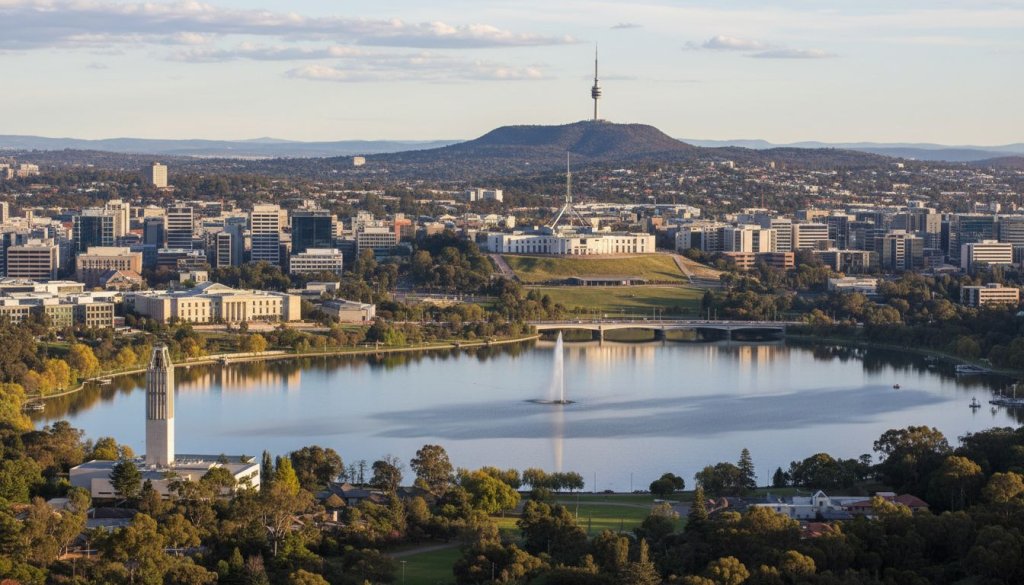
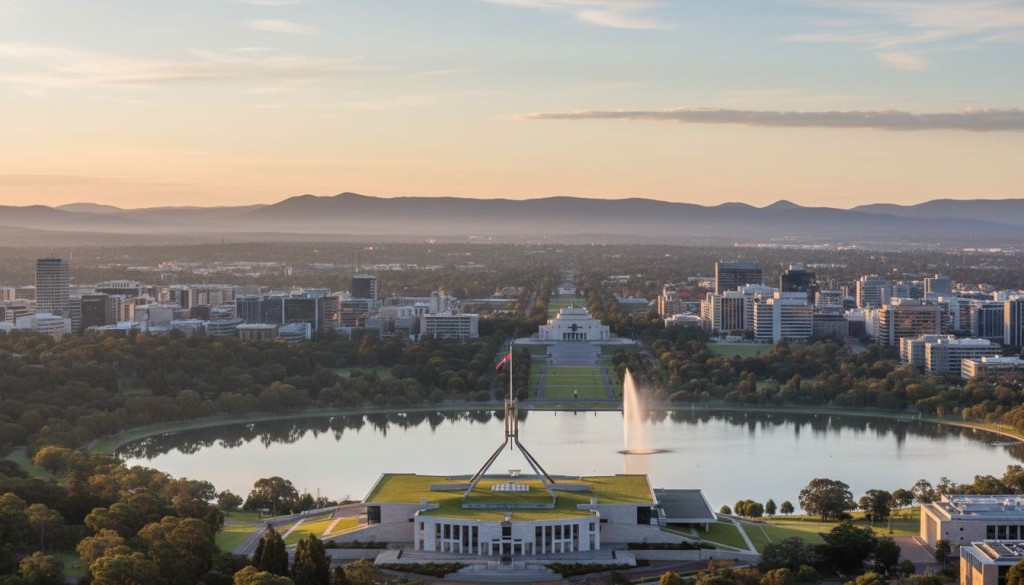
Canberra viewed from Mount Ainslie
National Carillon
Australian War Memorial
Telstra Tower
National Library of Australia
National Gallery of Australia
Capital Hill and Old Parliament House
|
|
Canberra
|

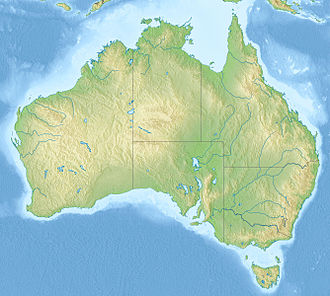
Coordinates: 35°17′35″S 149°07′37″E / 35.29306°S 149.12694°ECountryAustraliaStateAustralian Capital TerritoryLocation
Established12 March 1913Government
• Territory electorates
• Federal divisions
Area
2,358 km2 (910 sq mi)Elevation
578 m (1,896 ft)Population
• Total473,855 (June 2024)[8] (8th) • Density200.96/km2 (520.47/sq mi)Time zoneUTC+10:00 (AEST) • Summer (DST)UTC+11:00 (AEDT)Mean max temp20.4 °C (68.7 °F)Mean min temp7.0 °C (44.6 °F)Annual rainfall579.5 mm (22.81 in)
Canberra (/ˈkænbrÉ™/ ⓘ KAN-brÉ™; Ngunawal: Kanbarra) is the capital city of Australia and the only substantial settlement of the Australian Capital Territory. Founded following the federation of the colonies of Australia as the seat of government for the new nation, a compromise between Melbourne and Sydney, it is Australia's largest inland city, and the eighth-largest Australian city by population. The city is located at the northern tip of the Australian Alps, the country's highest mountain range. As of June 2024,[update] Canberra's estimated population was 473,855.
The area chosen for the capital had been inhabited by Aboriginal Australians for up to 21,000 years, by groups including the Ngunnawal and Ngambri. European settlement commenced in the first half of the 19th century, evidenced by surviving landmarks such as St John's Anglican Church and Blundells Cottage. On 1 January 1901, federation of the colonies of Australia was achieved. The capital city was founded and formally named as Canberra in 1913. Unusual among Australian cities, it is an entirely planned city, grounded in a design by American architects Walter Burley Griffin and Marion Mahony Griffin. The Griffins' plan was influenced by garden city movement and featured geometric motifs aligned with significant topographical landmarks such as Black Mountain, Mount Ainslie, Capital Hill and City Hill. Its design can be viewed from its highest point at the Telstra Tower and the summit of Mount Ainslie. Other notable features include the National Arboretum and Lake Burley Griffin.
As the seat of the Government of Australia, Canberra is home to many important institutions of the federal government, national monuments and museums. These include Parliament House, Government House, the High Court building and the headquarters of numerous government agencies. Social and cultural institutions of national significance include the Australian War Memorial, the Australian National University, the Royal Australian Mint, the Australian Institute of Sport, the National Gallery, the National Museum and the National Library. The city is home to many important institutions of the Australian Defence Force including the Royal Military College Duntroon and the Australian Defence Force Academy. It hosts all foreign embassies in Australia as well as regional headquarters of many international organisations, not-for-profit groups, lobbying groups and professional associations.
Canberra has been ranked among the world's best cities to live in and visit. Compared to the national averages, the unemployment rate is lower and the average income higher; tertiary education levels are higher, while the population is younger. At the 2021 Census, 28.7% of Canberra's inhabitants were reported as having been born overseas. The Australian Public Service accounted for about 25% all jobs as at November 2025. Other major industries include health care, professional services, education and training, retail, accommodation and food, and construction. Annual cultural events include Floriade, the largest flower festival in the Southern Hemisphere, the Enlighten Festival, Skyfire, the National Multicultural Festival and Summernats. Canberra's main sporting venues are Canberra Stadium and Manuka Oval. The city is served with domestic and international flights at Canberra Airport, while interstate train and coach services depart from Canberra railway station and the Jolimont Centre respectively. City Interchange and Alinga Street station form the hub of Canberra's bus and light rail transport network.
The word "Canberra" is derived from the Ngunnawal language of a local Ngunnawal or Ngambri clan who resided in the area and were referred to by the early British colonists as either the Canberry, Kanberri or Nganbra tribe.[10][11] Joshua John Moore, the first European land-owner in the region, named his grant "Canberry" in 1823 after these people. "Canberry Creek" and "Canberry" first appeared on regional maps from 1830, while the derivative name "Canberra" started to appear from around 1857.[12][13][14] Other early recorded variants of the spelling include "Canbury" (potentially influenced by the settlement of the same name in England), "Canburry" and "Kembery".[15]
Numerous local commentators, including the Ngunnawal elder Don Bell, have speculated upon possible meanings of "Canberra" over the years. These include "meeting place", "woman's breasts" and "the hollow between a woman's breasts".[16][17] References to breasts or the space between them are thought to derive from Black Mountain and Mount Ainslie, two large hills with similar elevations situated immediately to the northwest and northeast, respectively, of what is now the city centre.[18][19][20]
Alternative proposals for the name of the city during its planning included Austral, Australville, Aurora, Captain Cook, Caucus City, Cookaburra, Dampier, Eden, Eucalypta, Flinders, Gonebroke, Home, Hopetoun, Kangaremu, Myola, Meladneyperbane, New Era, Olympus, Paradise, Shakespeare, Sydmelperadbrisho, Swindleville, The National City, Union City, Unison, Wattleton, Wheatwoolgold, Yass-Canberra.[21][22][23]
The first peoples of the Canberra area include the Ngunnawal, Ngunawal and Ngambri peoples.[24]Other groups claiming a connection to the land include the Ngarigo (who also lived directly to the south) and the Ngambri-Guumaal.[10] Neighbouring groups include the Wandandian to the east, the Walgulu also to the south, Gandangara people to the north and Wiradjuri to the north-west.
The first British settlers into the Canberra area described two clans of Ngunnawal people resident to the vicinity. The Canberry or Nganbra clan lived mostly around Sullivan's Creek and had ceremonial grounds at the base of Galambary (Black Mountain), while the Pialligo clan had land around what is now Canberra Airport.[25][26] The people living here carefully managed and cultivated the land with fire, farmed yams, and hunted for food.[27]
Archaeological evidence of settlement in the region includes inhabited rock shelters, rock paintings and engravings, burial places, camps and quarry sites as well as stone tools and arrangements.[28] Artefacts suggests early human activity occurred at some point in the area 21,000 years previously.[29]
Still today, Ngunnawal men into the present conduct ceremony on the banks of the river, Murrumbidgee River. They travel upstream as they receive their Totems and corresponding responsibilities for land management. 'Murrum' means 'Pathway' and Bidgee means 'Boss'.[27]
The submerged limestone caves beneath Lake Burley Griffin contained Aboriginal rock art, some of the only sites in the region.[27]
Galambary (Black Mountain) is an important Aboriginal meeting and business site, predominantly for men's business. According to the Ngunnawal and Ngambri people, Mt Ainslie is primarily for place of women's business. Black Mountain and Mount Ainslie are referred to as women's breasts. Galambary was also used by Ngunnawal people as an initiation site, with the mountain itself said to represent the growth of a boy into a man.[27]


In October 1820, Charles Throsby Smith led the first British expedition to the area.[31][32][33][34] Four other expeditions occurred between 1820 and 1823 with the first accurate map being produced by explorer Mark John Currie in June 1823. By this stage, the area had become known as the Limestone Plains.[31][35]
British settlement of the area probably dates from late 1823, when a sheep station was formed on what is now the Acton Peninsula by James Cowan, the head stockman employed by Joshua John Moore.[36] Moore had received a land grant in the region in 1823 and formally applied to purchase the site on 16 December 1826. He named the property "Canberry". On 30 April 1827, Moore was told by letter that he could retain possession of 1,000 acres (405 ha) at Canberry.[37]
Other colonists soon followed Moore's example to take up land in the region. Around 1825, James Ainslie, working on behalf of the wealthy merchant Robert Campbell, arrived to establish a sheep station. He was guided to the region by a local Aboriginal girl who showed him the fine lands of her Pialligo clan.[25] The area then became the property of Campbell and it was initially named Pialligo before Campbell changed it to the Scottish title of Duntroon.[12][38][39] Campbell and his family built a dairy on the site in 1832, now regarded as the oldest standing European building in Canberra,[40][41][42] followed by the imposing stone house that is now the officers' mess of the Royal Military College, Duntroon.[43] The Campbells sponsored settlement by other farmer families to work their land, such as the Southwells of "Weetangera".[44]
Other notable early colonists included Henry Donnison, who established the Yarralumla estate—now the site of the official residence of the Governor-General of Australia—in 1827, and John Palmer who employed Duncan Macfarlane to form the Jerrabomberra property in 1828. A year later, John MacPherson established the Springbank estate, becoming the first British owner-occupier in the region.[12][45][46]
The Anglican church of St John the Baptist, in the suburb of Reid,[47] was consecrated in 1845, and is now the oldest surviving public building in the city.[48][49] St John's churchyard contains the earliest graves in the district.[50] It has been described as a "sanctuary in the city",[51][52] remaining a small English village-style church even as the capital grew around it. Canberra's first school, St John's School (now a museum), was situated next to the church and opened in the same year of 1845.[53] It was built to educate local settlers children,[54] including the Blundell children who lived in nearby Blundell's Cottage.[55]
As the European presence increased, the Indigenous population dwindled largely due to the destruction of their society, dislocation from their lands and from introduced diseases such as influenza, smallpox, alcoholism, and measles.[56][57]

The district's change from a rural area in New South Wales to the national capital started during debates over federation in the late 19th century.[58][59] Following a long dispute over whether Sydney or Melbourne should be the national capital,[60] a compromise was reached: the new capital would be built in New South Wales, so long as it was at least 100 mi (160 km) from Sydney,[58] with Melbourne to be the temporary seat of government while the new capital was built.[61] A survey was conducted across several sites in New South Wales with Bombala, southern Monaro, Orange, Yass, Albury, Tamworth, Armidale, Tumut, and Dalgety all discussed.[62] Dalgety was chosen by the federal parliament and it passed the Seat of Government Act 1904 confirming Dalgety as the site of the nation's capital. However, the New South Wales government refused to cede the required territory as they did not accept the site.[62] In 1906, the New South Wales Government finally agreed to cede sufficient land provided that it was in the Yass-Canberra region as this site was closer to Sydney.[58] Newspaper proprietor John Gale circulated a pamphlet titled 'Dalgety or Canberra: Which?' advocating Canberra to every member of the Commonwealth's seven state and federal parliaments. By many accounts, it was decisive in the selection of Canberra as the site in 1908 as was a result of survey work done by the government surveyor Charles Scrivener.[63] The NSW government ceded the district to the federal government in 1911 and the Federal Capital Territory was established.[58]

An international design competition was launched by the Department of Home Affairs on 30 April 1911, closing on 31 January 1912. The competition was boycotted by the Royal Institute of British Architects, the Institution of Civil Engineers and their affiliated bodies throughout the British Empire because the Minister for Home Affairs King O'Malley insisted that the final decision was for him to make rather than an expert in city planning.[64] A total of 137 valid entries were received. O'Malley appointed a three-member board to advise him but they could not reach unanimity. On 24 May 1911,[65] O'Malley came down on the side of the majority of the board with the design by Walter Burley Griffin and Marion Mahony Griffin of Chicago, Illinois, United States, being declared the winner.[66][67] Second was Eliel Saarinen of Finland and third was Alfred Agache of Brazil but resident in Paris, France.[64] O'Malley then appointed a six-member board to advise him on the implementation of the winning design. On 25 November 1912, the board advised that it could not support the Griffins' plan in its entirety and suggested an alternative plan of its own devising. This plan ostensibly incorporated the best features of the three place-getting designs as well as of a fourth design by H. Caswell, R.C.G. Coulter and W. Scott-Griffiths of Sydney, the rights to which it had purchased. It was this composite plan that was endorsed by Parliament and given formal approval by O'Malley on 10 January 1913.[64] However, it was the Griffin plan which was ultimately proceeded with. In 1913, Walter Burley Griffin was appointed Federal Capital Director of Design and Construction and construction began.[68] On 23 February, King O'Malley drove the first peg in the construction of the future capital city.
In 1912, the government invited suggestions from the public as to the name of the future city. Almost 750 names were suggested. At midday on 12 March 1913,[69][70] Lady Denman, the wife of Governor-General Lord Denman, announced that the city would be named "Canberra" at a ceremony at Kurrajong Hill,[71][72][73] which has since become Capital Hill and the site of the present Parliament House.[74] Canberra Day is a public holiday observed in the ACT on the second Monday in March to celebrate the founding of Canberra.[57] After the ceremony, bureaucratic disputes hindered Griffin's work;[75] a Royal Commission in 1916 ruled his authority had been usurped by certain officials and his original plan was reinstated.[76] Griffin's relationship with the Australian authorities was strained and a lack of funding meant that by the time he was fired in 1920, little work had been done.[77][78] By this time, Griffin had revised his plan, overseen the earthworks of major avenues and established the Glenloch Cork Plantation.[79][80]


The Commonwealth government purchased the pastoral property of Yarralumla in 1913 to provide an official residence for the Governor-General of Australia in the new capital.[81] Renovations began in 1925 to enlarge and modernise the property.[82] In 1927, the property was officially dubbed Government House.[81] On 9 May that year, the Commonwealth parliament moved to Canberra with the opening of the Provisional Parliament House.[83][84] The Prime Minister Stanley Bruce had officially taken up residence in The Lodge a few days earlier.[85][86] Planned development of the city slowed significantly during the depression of the 1930s and during World War II.[87] Some projects planned for that time, including Roman Catholic and Anglican cathedrals, were never completed.[88] (Nevertheless, in 1973 the Roman Catholic parish church of St. Christopher was remodelled into St Christopher's Cathedral, Manuka, serving the Archdiocese of Canberra and Goulburn. It is the only cathedral in Canberra.[89])
From 1920 to 1957, three bodies — successively the Federal Capital Advisory Committee,[90] the Federal Capital Commission,[91] and the National Capital Planning and Development Committee — continued to plan the further expansion of Canberra in the absence of Griffin. However, they were only advisory and development decisions were made without consulting them, which increased inefficiency.[79][92]
The largest event in Canberra up to World War II was the 24th Meeting of ANZAAS in January 1939. The Canberra Times described it as "a signal event ... in the history of this, the world's youngest capital city". The city's accommodation was not nearly sufficient to house the 1,250 delegates and a tent city had to be set up on the banks of the Molonglo River. One of the prominent speakers was H. G. Wells, who was a guest of the Governor-General Lord Gowrie for a week. This event coincided with a heatwave across south-eastern Australia during which the temperature in Canberra reached 108.5 degrees Fahrenheit (42.5 Celsius) on 11 January. On Friday, 13 January, the Black Friday bushfires caused 71 deaths in Victoria and Wells accompanied the Governor-General on his tour of areas threatened by fires.[93]
Immediately after the end of the war, Canberra was criticised for resembling a village and its disorganised collection of buildings was deemed ugly.[94][95][96] Canberra was often derisively described as "several suburbs in search of a city".[97] Prime Minister Sir Robert Menzies regarded the state of the national capital as an embarrassment.[98] Over time his attitude changed from one of contempt to that of championing its development. He fired two ministers charged with the development of the city for poor performance. Menzies remained in office for over a decade and in that time the development of the capital sped up rapidly.[99][100] The population grew by more than 50 per cent in every five-year period from 1955 to 1975.[100] Several Government departments, together with public servants, were moved to Canberra from Melbourne following the war.[101] Government housing projects were undertaken to accommodate the city's growing population.[102]
The National Capital Development Commission (NCDC) formed in 1957 with executive powers and ended four decades of disputes over the shape and design of Lake Burley Griffin — the centrepiece of Griffin's design — and construction was completed in 1964 after four years of work.[103] The completion of the lake finally laid the platform for the development of Griffin's Parliamentary Triangle.[104] Since the initial construction of the lake, various buildings of national importance have been constructed on its shores.[105]

The newly built Australian National University was expanded and sculptures as well as monuments were built.[105][106] A new National Library was constructed within the Parliamentary Triangle, followed by the High Court and the National Gallery.[47][107] Suburbs in Canberra Central (often referred to as North Canberra and South Canberra) were further developed in the 1950s and urban development in the districts of Woden Valley and Belconnen commenced in the mid and late 1960s respectively, followed by the district of Tuggeranong in the mid-1970s.[108][109][110] Many of the new suburbs were named after Australian politicians such as Barton, Deakin, Reid, Braddon, Curtin, Chifley and Parkes.[111]
On 9 May 1988, a larger and permanent Parliament House was opened on Capital Hill as part of Australia's bicentenary celebrations.[112][107] The Commonwealth Parliament moved there from the Provisional Parliament House, now known as Old Parliament House.[112]
In December 1988, the Australian Capital Territory was granted full self-government by the Commonwealth Parliament, a step proposed as early as 1965.[113] Following the first election on 4 March 1989,[114] a 17-member Legislative Assembly sat at temporary offices at 1 Constitution Avenue, Civic, on 11 May 1989.[115][116] Permanent premises were opened on London Circuit in 1994.[116] The Australian Labor Party formed the ACT's first government, led by the Chief Minister Rosemary Follett, who made history as Australia's first female head of government.[117][118] The 1990s also saw urban development begin in the district of Gungahlin in the far north of the ACT.[119][120]

Parts of Canberra were engulfed by bushfires on 18 January 2003 that killed four people, injured 435 and destroyed more than 500 homes as well as the major research telescopes of Australian National University's Mount Stromlo Observatory.[121]
Throughout 2013, several events celebrated the 100th anniversary of the naming of Canberra.[122] On 11 March 2014, the last day of the centennial year, the Canberra Centenary Column was unveiled in City Hill. Other works included The Skywhale, a hot air balloon designed by the sculptor Patricia Piccinini,[123] and StellrScope by visual media artist Eleanor Gates-Stuart.[124] On 7 February 2021, The Skywhale was joined by Skywhalepapa to create a Skywhale family, an event marked by Skywhale-themed pastries and beer produced by local companies as well as an art pop song entitled "We are the Skywhales".[125]
In 2014, Canberra was named the best city to live in the world by the Organisation for Economic Co-operation and Development,[126][127][128] and was named the third best city to visit in the world by Lonely Planet in 2017.[129][130]

Canberra is located near the Brindabella Ranges (part of the Australian Alps), approximately 150 km (93 mi) inland from Australia's east coast. Canberra is not incorporated, but its urban environs, which include a large part of the ACT east of the Murrumbidgee River, have an elevation of approximately 580 m (1,900 ft) AHD;[131] the highest point near the built up area is Mount Majura at 888 m (2,913 ft).[132][133] Other low mountains include Mount Taylor 855 m (2,805 ft),[134] Mount Ainslie 843 m (2,766 ft),[135] Mount Mugga Mugga 812 m (2,664 ft)[136] and Black Mountain 812 m (2,664 ft).[137][138]
The native forest in the Canberra region was almost wholly eucalypt species and provided a resource for fuel and domestic purposes. By the early 1960s, logging had depleted the eucalypt, and concern about water quality led to the forests being closed. Interest in forestry began in 1915 with trials of a number of species including Pinus radiata on the slopes of Mount Stromlo. Since then, plantations have been expanded, with the benefit of reducing erosion in the Cotter catchment, and the forests are also popular recreation areas.[139]

The urban environs of Canberra straddle the Ginninderra plain, Molonglo plain, the Limestone plain, and the Tuggeranong plain (Isabella's Plain).[140] The Molonglo River which flows across the Molonglo plain has been dammed to form the national capital's iconic feature Lake Burley Griffin.[141] The Molonglo then flows into the Murrumbidgee north-west of Canberra, which in turn flows north-west toward the New South Wales town of Yass. The Queanbeyan River joins the Molonglo River at Oaks Estate just within the ACT.[140]
A number of creeks, including Jerrabomberra and Yarralumla Creeks, flow into the Molonglo and Murrumbidgee.[140] Two of these creeks, the Ginninderra and Tuggeranong, have similarly been dammed to form Lakes Ginninderra and Tuggeranong.[142][143][144] Until recently the Molonglo River had a history of sometimes calamitous floods; the area was a flood plain prior to the filling of Lake Burley Griffin.[145][146]

Under the Köppen-Geiger classification, Canberra has an oceanic climate (Cfb).[147] In January, the warmest month, the average high is approximately 29 °C (84 °F); in July, the coldest month, the average high drops to approximately 12 °C (54 °F).
Frost is common in the winter months. Snow is rare in the CBD (central business district) due to being on the leeward (eastern) side of the dividing range, but the surrounding areas get annual snowfall through winter and often the snow-capped Brindabella Range can be seen from the CBD. The last significant snowfall in the city centre was in 1968.[131]
The highest recorded maximum temperature was 44.0 °C (111.2 °F) on 4 January 2020.[148] Winter 2011 was Canberra's warmest winter on record, approximately 2 °C (4 °F) above the average temperature.[149]

The lowest recorded minimum temperature was −10.0 °C (14.0 °F) on the morning of 11 July 1971.[131] Light snow falls only once in every few years, and is usually not widespread and quickly dissipates.[131]
Canberra is protected from the west by the Brindabellas which create a strong rain shadow in Canberra's valleys.[131] Canberra gets 100.4 clear days annually.[150] Annual rainfall is the third lowest of the capital cities (after Adelaide and Hobart)[151] and is spread fairly evenly over the seasons, with late spring bringing the highest rainfall.[152] Thunderstorms occur mostly between October and April, owing to the effect of summer and the mountains.[131]
The area is generally sheltered from a westerly wind, though strong northwesterlies can develop. A cool, vigorous afternoon easterly change, colloquially referred to as a 'sea-breeze' or the 'Braidwood Butcher',[153][154] is common during the summer months[155] and often exceeds 40 km/h in the city. Canberra is also less humid than the nearby coastal areas.[131]
Canberra was severely affected by smoke haze during the 2019/2020 bushfires. On 1 January 2020, Canberra had the worst air quality of any major city in the world, with an AQI of 7700 (USAQI 949).[156]
| Climate data for Canberra Airport Comparison (1991–2010 averages, extremes 1939–2023); 578 m AMSL; 35.30° S, 149.20° E | |||||||||||||
|---|---|---|---|---|---|---|---|---|---|---|---|---|---|
| Month | Jan | Feb | Mar | Apr | May | Jun | Jul | Aug | Sep | Oct | Nov | Dec | Year |
| Record high °C (°F) | 44.0 (111.2) |
42.7 (108.9) |
37.5 (99.5) |
32.6 (90.7) |
24.5 (76.1) |
20.1 (68.2) |
19.7 (67.5) |
24.0 (75.2) |
30.2 (86.4) |
32.7 (90.9) |
39.9 (103.8) |
41.6 (106.9) |
44.0 (111.2) |
| Mean maximum °C (°F) | 37.2 (99.0) |
34.8 (94.6) |
31.8 (89.2) |
26.3 (79.3) |
21.6 (70.9) |
17.3 (63.1) |
15.8 (60.4) |
18.8 (65.8) |
23.1 (73.6) |
27.4 (81.3) |
32.0 (89.6) |
35.0 (95.0) |
37.9 (100.2) |
| Mean daily maximum °C (°F) | 28.8 (83.8) |
27.8 (82.0) |
24.9 (76.8) |
20.7 (69.3) |
16.6 (61.9) |
12.9 (55.2) |
12.1 (53.8) |
13.8 (56.8) |
16.8 (62.2) |
20.1 (68.2) |
23.4 (74.1) |
26.5 (79.7) |
20.4 (68.7) |
| Daily mean °C (°F) | 21.4 (70.5) |
20.8 (69.4) |
17.9 (64.2) |
13.7 (56.7) |
10.0 (50.0) |
7.3 (45.1) |
6.2 (43.2) |
7.5 (45.5) |
10.4 (50.7) |
13.4 (56.1) |
16.5 (61.7) |
19.3 (66.7) |
13.7 (56.7) |
| Mean daily minimum °C (°F) | 14.0 (57.2) |
13.8 (56.8) |
10.9 (51.6) |
6.6 (43.9) |
3.4 (38.1) |
1.6 (34.9) |
0.3 (32.5) |
1.2 (34.2) |
4.0 (39.2) |
6.7 (44.1) |
9.6 (49.3) |
12.1 (53.8) |
7.0 (44.6) |
| Mean minimum °C (°F) | 7.7 (45.9) |
7.7 (45.9) |
4.1 (39.4) |
−0.3 (31.5) |
−3.1 (26.4) |
−5.0 (23.0) |
−5.2 (22.6) |
−4.7 (23.5) |
−2.2 (28.0) |
−0.1 (31.8) |
2.2 (36.0) |
5.3 (41.5) |
−5.9 (21.4) |
| Record low °C (°F) | 1.6 (34.9) |
2.8 (37.0) |
−1.1 (30.0) |
−3.7 (25.3) |
−7.5 (18.5) |
−8.5 (16.7) |
−10.0 (14.0) |
−8.5 (16.7) |
−6.9 (19.6) |
−3.4 (25.9) |
−2.3 (27.9) |
−0.3 (31.5) |
−10.0 (14.0) |
| Average precipitation mm (inches) | 61.3 (2.41) |
55.2 (2.17) |
37.6 (1.48) |
27.3 (1.07) |
31.5 (1.24) |
50.0 (1.97) |
44.3 (1.74) |
43.1 (1.70) |
55.8 (2.20) |
50.9 (2.00) |
68.4 (2.69) |
54.1 (2.13) |
579.5 (22.81) |
| Average precipitation days (≥ 0.2 mm) | 6.8 | 6.7 | 5.7 | 5.4 | 6.3 | 9.7 | 10.0 | 8.5 | 9.8 | 9.1 | 10.2 | 7.2 | 95.4 |
| Average afternoon relative humidity (%) | 37 | 40 | 42 | 46 | 54 | 60 | 58 | 52 | 49 | 47 | 41 | 37 | 47 |
| Average dew point °C (°F) | 8.6 (47.5) |
9.8 (49.6) |
8.5 (47.3) |
6.4 (43.5) |
5.0 (41.0) |
3.5 (38.3) |
2.3 (36.1) |
2.1 (35.8) |
3.7 (38.7) |
5.4 (41.7) |
6.3 (43.3) |
6.9 (44.4) |
5.7 (42.3) |
| Mean monthly sunshine hours | 294.5 | 254.3 | 251.1 | 219.0 | 186.0 | 156.0 | 179.8 | 217.0 | 231.0 | 266.6 | 267.0 | 291.4 | 2,813.7 |
| Source 1: Climate averages for Canberra Airport Comparison (1939–2010); averages given are for 1991–2010[150][157][158] | |||||||||||||
| Source 2: Records from Canberra Airport for more recent extremes[159] | |||||||||||||
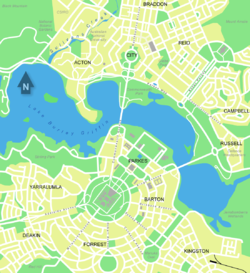

Unusual among Australian cities, Canberra is an entirely planned city, grounded in a design by American architects Walter Burley Griffin and Marion Mahony Griffin.[160][161][162] Within the central area of the city near Lake Burley Griffin, major roads follow a wheel-and-spoke pattern rather than a grid.[163] Griffin's proposal had an abundance of geometric patterns, including concentric hexagonal and octagonal streets emanating from several radii.[163] However, the outer areas of the city, built later, are not laid out geometrically.[164]
Lake Burley Griffin was deliberately designed so that the orientation of the components was related to various topographical landmarks in Canberra.[165][166] The lakes stretch from east to west and divided the city in two; a land axis perpendicular to the central basin stretches from Capital Hill—the eventual location of the new Parliament House on a mound on the southern side—north northeast across the central basin to the northern banks along Anzac Parade to the Australian War Memorial.[95] This was designed so that looking from Capital Hill, the War Memorial stood directly at the foot of Mount Ainslie. At the southwestern end of the land axis was Bimberi Peak,[166] the highest mountain in the ACT, approximately 52 km (32 mi) south west of Canberra.[138]
The straight edge of the circular segment that formed the central basin of Lake Burley Griffin was perpendicular to the land axis and designated the water axis, and it extended northwest towards Black Mountain.[166] A line parallel to the water axis, on the northern side of the city, was designated the municipal axis.[167] The municipal axis became the location of Constitution Avenue, which links City Hill in Civic Centre and both Market Centre and the Defence precinct on Russell Hill. Commonwealth Avenue and Kings Avenue were to run from the southern side from Capital Hill to City Hill and Market Centre on the north respectively, and they formed the western and eastern edges of the central basin. The area enclosed by the three avenues was known as the Parliamentary Triangle, and formed the centrepiece of Griffin's work.[166][167]

The Griffins assigned spiritual values to Mount Ainslie, Black Mountain, and Red Hill and originally planned to cover each of these in flowers. That way each hill would be covered with a single, primary colour which represented its spiritual value.[168] This part of their plan never came to fruition, as World War I slowed construction and planning disputes led to Griffin's dismissal by Prime Minister Billy Hughes after the war ended.[77][78][169]
The urban areas of Canberra are organised into a hierarchy of districts, town centres, group centres, local suburbs as well as other industrial areas and villages. There are seven residential districts, each of which is divided into smaller suburbs, and most of which have a town centre which is the focus of commercial and social activities.[170] The districts were settled in the following chronological order:
The Canberra Central district is substantially based on Walter Burley Griffin's designs.[166][167][176] In 1967 the then National Capital Development Commission adopted the "Y Plan" which laid out future urban development in Canberra around a series of central shopping and commercial area known as the 'town centres' linked by freeways, the layout of which roughly resembled the shape of the letter Y,[177] with Tuggeranong at the base of the Y and Belconnen and Gungahlin located at the ends of the arms of the Y.[177]
Development in Canberra has been closely regulated by government,[178][179] both through planning processes and the use of crown lease terms that have tightly limited the use of parcels of land. Land in the ACT is held on 99-year crown leases from the national government, although most leases are now administered by the Territory government.[180] There have been persistent calls for constraints on development to be liberalised,[179] but also voices in support of planning consistent with the original 'bush capital' and 'urban forest' ideals that underpin Canberra's design.[181]
Many of Canberra's suburbs are named after former Prime Ministers, famous Australians, early settlers, or use Aboriginal words for their title.[182] Street names typically follow a particular theme; for example, the streets of Duffy are named after Australian dams and reservoirs, the streets of Dunlop are named after Australian inventions, inventors and artists and the streets of Page are named after biologists and naturalists.[182] Most diplomatic missions are located in the suburbs of Yarralumla, Deakin, and O'Malley.[183] There are three light industrial areas: the suburbs of Fyshwick, Mitchell, and Hume.[184]

1
2
3
4
5
6
7
8
9
10
11
12
13
14
15
16
17
18
19
20
21
|
||||||||||||||||||||||||||||||||||||||||||||||
Points of Interest Looking South from Mount Ainslie
|
||||||||||||||||||||||||||||||||||||||||||||||
The average Canberran was responsible for 13.7 tonnes of greenhouse gases in 2005.[185] In 2012, the ACT Government legislated greenhouse gas targets to reduce its emissions by 40 per cent from 1990 levels by 2020, 80 per cent by 2050, with no net emissions by 2060.[186] The government announced in 2013 a target for 90% of electricity consumed in the ACT to be supplied from renewable sources by 2020,[187] and in 2016 set an ambitious target of 100% by 2020.[188][189] Canberra achieved 100% renewable electricity in 2020 and the ACT Government committed in 2024 to Canberra using 100% renewable energy in 2045.[190]
In 1996, Canberra became the first city in the world to set a vision of no waste, proposing an ambitious target of 2010 for completion.[191] The strategy aimed to achieve a waste-free society by 2010, through the combined efforts of industry, government and community.[192] By early 2010, it was apparent that though it had reduced waste going to landfill, the ACT initiative's original 2010 target for absolutely zero landfill waste would be delayed or revised to meet the reality.[193][194]
Plastic bags made of polyethylene polymer with a thickness of less than 35 μm were banned from retail distribution in the ACT from November 2011.[195][196][197] The ban was introduced by the ACT Government in an effort to make Canberra more sustainable.[196]
Of all waste produced in the ACT, 75 per cent is recycled.[198] Average household food waste in the ACT remains above the Australian average, costing an average $641 per household per annum.[199]

There is no local council or city government for Canberra, which thus has no precise definition. The Australian Capital Territory Legislative Assembly administers both the urban area and the rest of the Australian Capital Territory.[116] At the 2021 census, all but 888 people were calculated to reside in the urban area of Canberra.[200][201]
The assembly consists of 25 members elected from five districts using proportional representation. The five districts are Brindabella, Ginninderra, Kurrajong, Murrumbidgee and Yerrabi, which each elect five members.[202] The Chief Minister is elected by the Members of the Legislative Assembly (MLA) and selects colleagues to serve as ministers alongside him or her in the Executive, known informally as the cabinet.[116]
Whereas the ACT has federally been dominated by Labor,[203][204] the Liberals have been able to gain some footing in the ACT Legislative Assembly and were in government during a period of 6+1⁄2 years from 1995 and 2001. Labor took back control of the Assembly in 2001.[117] At the 2004 election, Chief Minister Jon Stanhope and the Labor Party won 9 of the 17 seats allowing them to form the ACT's first majority government.[117] Since 2008, the ACT has been governed by a coalition of Labor and the Greens.[117][205][206] As of 2022[update], the Chief Minister was Andrew Barr from the Australian Labor Party.
The Australian federal government retains some influence over the ACT government. In the administrative sphere, most frequently this is through the actions of the National Capital Authority which is responsible for planning and development in areas of Canberra which are considered to be of national importance or which are central to Griffin's plan for the city,[207] such as the Parliamentary Triangle, Lake Burley Griffin, major approach and processional roads, areas where the Commonwealth retains ownership of the land or undeveloped hills and ridge-lines (which form part of the Canberra Nature Park).[207][208][209] The national government also retains a level of control over the Territory Assembly through the provisions of the Australian Capital Territory (Self-Government) Act 1988.[210] This federal act defines the legislative power of the ACT assembly.[211]
The ACT was given its first federal parliamentary representation in 1949 when it gained a seat in the House of Representatives, the Division of Australian Capital Territory.[212][213] However, until 1966, the ACT member could only vote on matters directly affecting the territory and did not count for purposes of forming government.[213] In 1974, the ACT was allocated two Senate seats and the House of Representatives seat was divided into two.[212] A third was created in 1996, but was abolished in 1998 because of changes to the regional demographic distribution.[203] A third seat was recreated at a redistribution in 2018 as the Division of Bean.[214] The House of Representatives seats have mostly been held by Labor and usually by comfortable margins.[203][204] The Labor Party has held all seats at every federal election since 1980, although it lost a byelection for the Division of Canberra in 1995.[117] The ALP and the Liberal Party held one Senate seat each until the 2022 election when Independent candidate David Pocock unseated the Liberal candidate Zed Seselja.[215]

The Australian Federal Police (AFP) provides all of the constabulary services in the territory in a manner similar to state police forces, under a contractual agreement with the ACT Government, through its community policing arm, ACT Policing.[216] People who have been charged with offences are tried either in the ACT Magistrates Court or, for more severe offences, the ACT Supreme Court.[217] Since 2009, prisoners, including those on remand have been held at the Alexander Maconochie Centre.[218] The ACT Civil and Administrative Tribunal deal with minor civil law actions and other various legal matters.[219]
Canberra is often descibed as Australia's safest city.[220] As of 2024[update], the most common crimes in the ACT were property related crimes, unlawful entry with intent and motor vehicle theft. They affected 1,449 and 920 people (305 and 193 per 100,000 persons respectively). Rates of sexual assault, 428 (89 per 100,000 persons) are also below the national average (147 per 100,000). These rates are lower than the equivalent figures for other states and the Northern Territory, except for motor vehicle theft.[221][222]

In November 2025, the unemployment rate in Canberra was 4.4%, almost identical with the national unemployment rate of 4.3%.[223] Canberra had a higher median level of weekly personal income than any Australian state capital (which ranged from $762 to $881) at the 2021 census. The median level of personal income was $1,204 compared with the national average of $805.[224][225][226][227][228][229][230] The median house price in Canberra as of December 2025 was $893,907, lower than Sydney, Brisbane, Perth and Adelaide, but higher than Melbourne, Hobart and Darwin, among capital cities.[231] Median weekly rents in Canberra in June 2025 of $677 were similarly about midway in comparison with other state and territory capital cities.[232]


The city's main industry is public administration and safety, which accounted for 27.1% of Gross Territory Product in 2018-19 and employed 32.49% of Canberra's workforce.[233][234] The Australian Public Service accounted for about 25% all jobs as at November 2025.[235][236] The headquarters of many Australian Public Service agencies are located in Canberra, and Canberra is also host to several Australian Defence Force establishments, most notably the Australian Defence Force headquarters and HMAS Harman, which is a naval communications centre that is being converted into a tri-service, multi-user depot.[237] Other major sectors by employment include Health Care (10.54%), Professional Services (9.77%), Education and Training (9.64%), Retail (7.27%), Accommodation & Food (6.39%) and Construction (5.80%).
[234]

The former RAAF Fairbairn, adjacent to the Canberra Airport was sold to the operators of the airport,[238] but the base continues to be used for RAAF VIP flights.[239][240] A growing number of software vendors have based themselves in Canberra, to capitalise on the concentration of government customers; these include Tower Software and RuleBurst.[241][242] A consortium of private and government investors is making plans for a billion-dollar data hub, with the aim of making Canberra a leading centre of such activity in the Asia-Pacific region.[243] A Canberra Cyber Security Innovation Node was established in 2019 to grow the ACT's cyber security sector and related space, defence and education industries.[244]

As of June 2024, Canberra's estimated population, including the whole of the ACT, was 473,855.[8] At the 2021 census, the population of the ACT was 453,558,[200] while the population of the Canberra built-up area was 452,670, so 888 were located in the rural part of the ACT.[201] This was up from 395,790 at the 2016 census,[245] and 355,596 at the 2011 census.[246] Canberra has been the fastest-growing city in Australia in recent years, having grown 23.3% from 2011 to 2021.[200]
Canberrans are relatively young, highly mobile and well educated. In 2021, the median age was 35 years and only 13.8% of the population was aged over 65 years.[201] Between 1996 and 2001, 61.9% of the population either moved to or from Canberra, which was the second highest mobility rate of any Australian capital city.[247] A 2024 report from the Australian Bureau of Statistics indicates that 49% of ACT residents aged 15–74 held a bachelor's degree or higher, the highest proportion among all Australian states and territories.[248] According to statistics collected by the National Australia Bank, Canberrans on average gave significantly more money to charity in 2014 than Australians in other states and territories, for both dollar giving and as a proportion of income.[249]
| Birthplace[N 1] | Population |
|---|---|
| Australia | 306,896 |
| India | 17,203 |
| England | 13,245 |
| China (including SARs and Taiwan) | 12,149 |
| Nepal | 5,689 |
| New Zealand | 5,122 |
At the 2021 census, the most commonly nominated ancestries were:[N 2][250]
The 2021 census showed that 28.7% of Canberra's inhabitants were born overseas.[250] Of inhabitants born outside Australia, the most prevalent countries of birth were India, England, China and Nepal.[252] 2.0% of the population, or 8,949 people, identified as Indigenous Australians (Aboriginal Australians and Torres Strait Islanders) in 2021. This was an increase from 6,508 counted in 2016, and lower than the Australian percentage of 3.2% in 2021.[N 4][250]
At the 2021 census, 71.3% of people spoke only English at home, down from 72.7% in 2016. The other languages most commonly spoken at home were Mandarin (3.2%), Nepali (1.3%), Vietnamese (1.1%), Punjabi (1.1%) and Hindi (1.0%).[250]
In 2021, the main religious affiliation in the ACT was Catholicism (19.3%), Anglicanism (8.2%) and Hinduism (4.5%). 43.5% described themselves as having no religion and 5.2 did not state a religion.[201]

The two main tertiary institutions are the Australian National University (ANU) in Acton, with over 10,200 undergraduate and over 7,100 postgraduate students,[253] and the University of Canberra (UC) in Bruce, with over 11,800 undergraduate and 6,300 postgraduate students.[254] Established in 1946,[255] the ANU has always had a strong research focus and is ranked among the leading universities in the world and the best in Australia by The Times Higher Education Supplement and the Shanghai Jiao Tong World University Rankings.[254][256] There are two religious university campuses in Canberra: Signadou in the northern suburb of Watson is a campus of the Australian Catholic University;[257] St Mark's Theological College in Barton is part of the secular Charles Sturt University.[258] The ACT Government announced on 5 March 2020 that the CIT campus and an adjoining carpark in Reid would be leased to the University of New South Wales (UNSW) for a peppercorn lease, for it to develop as a campus for a new UNSW Canberra.[259] UNSW released a master plan in 2021 for a 6,000 student campus to be realised over 15 years at a cost of $1 billion.[260]
The Australian Defence College has two campuses: the Australian Command and Staff College (ACSC) plus the Centre for Defence and Strategic Studies (CDSS) at Weston, and the Australian Defence Force Academy (ADFA) beside the Royal Military College, Duntroon located in the inner-northern suburb of Campbell.[261][262] ADFA teaches military undergraduates and postgraduates and includes UNSW@ADFA, a campus of the University of New South Wales;[263][264] Duntroon provides Australian Army officer training.[265]
Tertiary level vocational education is also available through the Canberra Institute of Technology (CIT), with campuses in Bruce, Reid, Gungahlin, Tuggeranong and Fyshwick.[266] The combined enrolment of the CIT campuses was over 28,000 students in 2019.[267] Following the transfer of land in Reid for the new UNSW Canberra, a new CIT Woden is scheduled to be completed by 2025.[268]
In 2016 there were 132 schools in Canberra; 87 were operated by the government and 45 were private.[269] During 2006, the ACT Government announced closures of up to 39 schools, to take effect from the end of the school year, and after a series of consultations unveiled its Towards 2020: Renewing Our Schools policy.[270] As a result, some schools closed during the 2006–08 period, while others were merged; the creation of combined primary and secondary government schools was to proceed over a decade. The closure of schools provoked significant opposition.[271][272][273] Most suburbs were planned to include a primary and a nearby preschool; these were usually located near open areas where recreational and sporting activities were easily available.[274] Canberra also has the highest percentage of non-government (private) school students in Australia, accounting for 40.6 per cent of ACT enrollments.[275]

Canberra is home to many national monuments and institutions such as the Australian War Memorial, the Australian Institute of Aboriginal and Torres Strait Islander Studies, the National Gallery of Australia, the National Portrait Gallery, the National Library,[176] the National Archives,[276] the Australian Academy of Science,[277] the National Film & Sound Archive and the National Museum.[176] Many Commonwealth government buildings in Canberra are open to the public, including Parliament House, the High Court and the Royal Australian Mint.[278][279][280]

Lake Burley Griffin is the site of the Captain James Cook Memorial and the National Carillon.[176] Other sites of interest include the Australian–American Memorial, Commonwealth Park, Commonwealth Place, the Telstra Tower, the Australian National Botanic Gardens, the National Zoo and Aquarium, the National Dinosaur Museum, and Questacon – the National Science and Technology Centre.[176][281]

The Canberra Museum and Gallery in the city is a repository of local history and art, housing a permanent collection and visiting exhibitions.[282] Several historic homes are open to the public: Lanyon and Tuggeranong Homesteads in the Tuggeranong Valley,[283][284] Mugga-Mugga in Symonston,[285] and Blundells' Cottage in Parkes all display the lifestyle of the early European settlers.[30] Calthorpes' House in Red Hill is a well-preserved example of a 1920s house from Canberra's very early days.[286] Strathnairn Homestead is an historic building which also dates from the 1920s.[287] The Schoolhouse Museum at St John's Anglican Church in Reid showcases school life in the 1840s.[288]

Canberra has many venues for live music and theatre: the Canberra Theatre and Playhouse which hosts many major concerts and productions;[289] and Llewellyn Hall (within the ANU School of Music), a world-class concert hall are two of the most notable.[290] The Street Theatre is a venue with less mainstream offerings.[290] The Albert Hall was the city's first performing arts venue, opened in 1928. It was the original performance venue for theatre groups such as the Canberra Repertory Society.[291]

There are numerous bars and nightclubs which also offer live entertainment, particularly concentrated in the areas of Dickson, Kingston and the city.[292] Most town centres have facilities for a community theatre and a cinema, and they all have a library.[293]

Canberra's annual Floriade is the largest flower festival in the Southern Hemisphere. It features a large display of flowers every Spring in Commonwealth Park.[295][296] Popular cultural events include the National Folk Festival, the Royal Canberra Show, the Summernats car festival, Enlighten festival, the National Multicultural Festival in February and the Celebrate Canberra festival held over 10 days in March in conjunction with Canberra Day.[297]
As Australia's capital, Canberra is the most important centre for much of Australia's political reportage and thus all the major media, including the Australian Broadcasting Corporation, the commercial television networks, and the metropolitan newspapers maintain local bureaus. News organisations are represented in the press gallery, a group of journalists who report on the national parliament. The National Press Club of Australia in Barton has regular television broadcasts of its lunches at which a prominent guest, typically a politician or other public figure, delivers a speech followed by a question-and-answer session.[298]
Canberra has a daily newspaper, The Canberra Times, which was established in 1926.[299][300] There are also several free weekly publications, including news magazines CityNews and Canberra Weekly as well as entertainment guide BMA Magazine. BMA Magazine first went to print in 1992; the inaugural edition featured coverage of the Nirvana Nevermind tour.[301]
There are a number of AM and FM stations broadcasting in Canberra (AM/FM Listing). The main commercial operators are the Capital Radio Network (2CA and 2CC), and Austereo/ARN (104.7 and Mix 106.3). There are also several community operated stations.
A DAB+ digital radio trial is also in operation, it simulcasts some of the AM/FM stations, and also provides several digital only stations (DAB+ Trial Listing).
Five free-to-air television stations service Canberra:
Each station broadcasts a primary channel and several multichannels. Of the three main commercial networks:
Prior to 1989, Canberra was serviced by just the ABC, SBS and Capital Television (CTC), which later became Ten Capital in 1994 then Southern Cross Ten in 2002 then Channel 9/Southern Cross Nine in 2016 and finally Channel 10 in 2021, with Prime Television (now Prime7) and WIN Television arriving as part of the Government's regional aggregation program in that year.[302]
Pay television services are available from Foxtel (via satellite) and telecommunications company TransACT (via cable).[303]

In addition to local sporting leagues, Canberra has a number of sporting teams that compete in national and international competitions. The best known teams are the Canberra Raiders and the ACT Brumbies who play rugby league and rugby union respectively; both have been champions of their leagues.[304][305] Both teams play their home games at Canberra Stadium,[306] which was used to hold group matches in football for the 2000 Summer Olympics[307] and in rugby union for the 2003 Rugby World Cup.[308] Canberra United represents the city in the A-League Women (formerly the W-League), the national women's soccer league and were champions in 2014.[309] The ACT division of the Australian Football League bid for a club for the national competition in 1981.[310] The league has rejected numerous such proposals over the years and, since 2013, it has designated Canberra as being represented by the Greater Western Sydney Giants,[311] which has played three home games at Manuka Oval each season since 2013[312] with support from the ACT Government.[313] The city also has a successful basketball team, the Canberra Capitals, which has won nine national women's basketball titles, most recently in 2019-20.[314] The historic Prime Minister's XI cricket match is played at Manuka Oval annually.[315] Other significant annual sporting events include the annual Canberra Marathon, established in 1976,[316] and the Challenge Canberra middle distance triathlon race was established in 2023.[317] The Canberra Tennis International has been held at the Canberra Tennis Centre, Lyneham since 2015,[318] usually annually.[319]

The Australian Institute of Sport (AIS) is located in the Canberra suburb of Bruce.[320] The AIS is a specialised educational and training institution providing coaching for elite junior and senior athletes in a number of sports. The AIS has been operating since 1981 and has achieved significant success in producing elite athletes, both local and international.[320] The majority of Australia's team members and medallists at the 2000 Summer Olympics in Sydney were AIS graduates.[321]
A Canberra-wide series of bicycle paths are available to cyclists for recreational and sporting purposes.[322] Canberra Nature Parks have a large range of walking paths, horse and mountain bike trails.[323] Water sports like sailing, rowing and dragon boating are held on Canberra's lakes.[324][325] A popular form of exercise for people working near or in the Parliamentary Triangle is to do the "bridge to bridge walk/run" of about 5 km around Lake Burley Griffin, crossing the Commonwealth Avenue Bridge and Kings Avenue Bridge, using the paths beside the lake. The walk takes about 1 hour, making it ideal for a lunchtime excursion. This is also popular on weekends. Such was the popularity during the COVID-19 isolation in 2020 that the ACT Government initiated a 'Clockwise is COVID-wise' rule for walkers and runners.[324][326]
| Club | League | Sport | Venue | Established |
|---|---|---|---|---|
| ACT Meteors | WNCL | Cricket | Manuka Oval | 2009[327] |
| ACT Brumbies Men's | Super Rugby | Rugby Union | GIO Stadium | 1995[328] |
| ACT Brumbies Women | Super Rugby Women's | Rugby Union | GIO Stadium/Viking Park | 2018[329] |
| Canberra Raiders | NRL | Rugby League | GIO Stadium | 1981[330] |
| Canberra Raiders Women's | NRLW | Rugby League | GIO Stadium | 2022[331] |
| Canberra United FC | A-League Women | Soccer | McKellar Park | 2008[332] |
| Canberra Brave | AIHL | Ice hockey | Phillip Ice Skating Centre | 2014[333] |
| Canberra Chill | Hockey One | Field hockey | National Hockey Centre | 2019[334] |
| University of Canberra Capitals | WNBL | Basketball | AIS Arena | 1986[335] |

Canberra has two large public hospitals, the approximately 600-bed Canberra Hospital—formerly the Woden Valley Hospital—in Garran and the 250-bed North Canberra Hospital in Bruce.[336][337] The latter was called Calvary Public Hospital Bruce before its acquisition by the ACT Government in 2023.[338][339] Both are teaching institutions.[337] The largest private hospital is the Calvary John James Hospital in Deakin.[340][341] Calvary Bruce Private Hospital[342] in Bruce and Healthscope's National Capital Private Hospital [343] in Garran are also major healthcare providers.
The Royal Canberra Hospital was located on Acton Peninsula on Lake Burley Griffin; it was closed in 1991 and was demolished in 1997 in a controversial and fatal implosion to facilitate construction of the National Museum of Australia.[105][167][176][344][345] The city has 10 aged care facilities. Canberra's hospitals receive emergency cases from throughout southern New South Wales,[346] and ACT Ambulance Service is one of four operational agencies of the ACT Emergency Services Authority.[347] NETS provides a dedicated ambulance service for inter-hospital transport of sick newborns within the ACT and into surrounding New South Wales.[348]


The automobile is by far the dominant form of transport in Canberra.[349] The city is laid out so that arterial roads connecting inhabited clusters run through undeveloped areas of open land or forest, which results in a low population density;[350] this also means that idle land is available for the development of future transport corridors if necessary without the need to build tunnels or acquire developed residential land. In contrast, other capital cities in Australia have substantially less green space.[351]
Canberra's districts are generally connected by parkways—limited access dual carriageway roads[349][352] with speed limits generally set at a maximum of 100 km/h (62 mph).[353][354] An example is the Tuggeranong Parkway which links Canberra's CBD and Tuggeranong, and bypasses Weston Creek.[355] In most districts, discrete residential suburbs are bounded by main arterial roads with only a few residential linking in, to deter non-local traffic from cutting through areas of housing.[356]
In 1974 the National Capital Development Commission announced a shift in transport planning to prioritise public transport and discourage commuting by car.[357]
The Commission's Transport Policy was a progressive, possibly radical, approach to transport planning for the time. Unwilling to accept the advice of a 1977 traffic study, the NCDC abandoned its commitment to expert-led planning, suppressed the modelling report and revived its car-oriented transport plans from the 1960s.[358] This led to Canberra being a car-dominated city today. In 2006 Canberrans were the most likely of any Australian city dwellers to use their cars to get to work.[359]
In an effort to improve road safety, traffic cameras were first introduced to Canberra by the Kate Carnell Government in 1999.[360] The traffic cameras installed in Canberra include fixed red-light and speed cameras and point-to-point speed cameras; together they bring in revenue of approximately $11 million per year in fines.[360]
ACTION, the government-operated bus service, provides public transport throughout the city.[361] CDC Canberra provides bus services between Canberra and nearby areas of New South Wales of (Murrumbateman and Yass)[362] and as Qcity Transit (Queanbeyan).[363] A light rail line commenced service on 20 April 2019 linking the CBD with the northern district of Gungahlin.[364] A planned Stage 2A of Canberra's light rail network will run from Alinga Street station to Commonwealth Park, adding three new stops at City West, City South and Commonwealth Park.[365] In February 2021 ACT Minister for Transport and City Services Chris Steel said he expects construction on Stage 2A to commence in the 2021-22 financial year, and for "tracks to be laid" by the next Territory election in 2024.[366] At the 2016 census, 7.1% of the journeys to work involved public transport, while 4.5% walked to work.[245]
There are two local taxi companies. Aerial Capital Group enjoyed monopoly status until the arrival of Cabxpress in 2007.[367] In October 2015 the ACT Government passed legislation to regulate ride sharing, allowing ride share services including Uber to operate legally in Canberra.[368][369][370] The ACT Government was the first jurisdiction in Australia to enact legislation to regulate the service.[371] Since then many other ride sharing and taxi services have started in ACT namely Ola, Glide Taxi[372] and GoCatch[373]
An interstate NSW TrainLink railway service connects Canberra to Sydney.[374] Canberra railway station is in the inner south suburb of Kingston.[375] Between 1920 and 1922 the train line crossed the Molonglo River and ran as far north as the city centre, although the line was closed following major flooding and was never rebuilt, while plans for a line to Yass were abandoned. A 3 ft 6 in (1,067 mm) gauge construction railway was built in 1923 between the Yarralumla brickworks and the provisional Parliament House; it was later extended to Civic, but the whole line was closed in May 1927.[376] Train services to Melbourne are provided by way of a NSW TrainLink bus service which connects with a rail service between Sydney and Melbourne in Yass, about a one-hour drive from Canberra.[374][377]
Plans to establish a high-speed rail service between Melbourne, Canberra and Sydney,[378] have not been implemented, as the various proposals have been deemed economically unviable.[379][380] The original plans for Canberra included proposals for railed transport within the city,[381] however none eventuated.[381] The phase 2 report of the most recent proposal, the High Speed Rail Study, was published by the Department of Infrastructure and Transport on 11 April 2013.[382] A railway connecting Canberra to Jervis Bay was also planned but never constructed.[383]
Canberra is about three hours by road from Sydney on the Federal Highway (National Highway 23),[384] which connects with the Hume Highway (National Highway 31) near Goulburn, and seven hours by road from Melbourne on the Barton Highway (National Highway 25), which joins the Hume Highway at Yass.[384] It is a two-hour drive on the Monaro Highway (National Highway 23) to the ski fields of the Snowy Mountains and the Kosciuszko National Park.[377] Batemans Bay, a popular holiday spot on the New South Wales coast, is also two hours away via the Kings Highway.[377]
Interstate coach services operate on these roads, with three companies operating a Sydney-Canberra express route: Murrays, FlixBus, and Greyhound Australia.[385] Other coach routes include: Murrays buses to Wollongong (via Moss Vale) and Narooma (via Batemans Bay); FlixBus buses to Melbourne (via Albury); V/Line buses to Wodonga (via Gundagai) and Bairnsdale and Traralgon (via Cooma); NSW TrainLink buses to Bombala and Eden (via Cooma), Wagga Wagga, Cootamundra and Goulburn; and CDC Canberra buses to Queanbeyan, Yass and Bungendore.[386]

Canberra Airport provides direct domestic services to Adelaide, Brisbane, Cairns, Darwin, Gold Coast, Hobart, Melbourne, Perth, Sunshine Coast and Sydney with connections to other domestic centres.[387] There are also direct flights to small regional towns: Ballina, Dubbo, Newcastle and Port Macquarie in New South Wales. Canberra Airport is, as of September 2013, designated by the Australian Government Department of Infrastructure and Regional Development as a restricted use designated international airport.[388] International flights have previously been operated by both Singapore Airlines and Qatar Airways. Fiji Airways has announced direct flights to Nadi commencing in July 2023.[389] Until 2003 the civilian airport shared runways with RAAF Base Fairbairn. In June of that year, the Air Force base was decommissioned and from that time the airport was fully under civilian control.[390]
Canberra has one of the highest rates of active travel of all Australian major cities, with 7.1 per cent of commuters walking or cycling to work in 2011.[391] An ACT Government survey conducted in late 2010 found that Canberrans walk an average of 26 minutes each day.[392] According to The Canberra Times in March 2014, Canberra's cyclists are involved in an average of four reported collisions every week.[393] The newspaper also reported that Canberra is home to 87,000 cyclists, translating to the highest cycling participation rate in Australia; and, with higher popularity, bike injury rates in 2012 were twice the national average.[394]
Since late 2020, two scooter-sharing systems have been operational in Canberra: orange scooters from Neuron Mobility and purple scooters from Beam Mobility,[395] both Singapore-based companies that operate in many Australian cities. These services cover much of Canberra Central and Central Belconnen, with plans to expand coverage to more areas of the city in 2022.[396]

The government-owned Icon Water manages Canberra's water and sewerage infrastructure.[398] ActewAGL is a joint venture between ACTEW and AGL, and is the retail provider of Canberra's utility services including water, natural gas, electricity, and also some telecommunications services via a subsidiary TransACT.[399]
Canberra's water is stored in four reservoirs, the Corin, Bendora and Cotter dams on the Cotter River and the Googong Dam on the Queanbeyan River. Although the Googong Dam is located in New South Wales, it is managed by the ACT government.[400] Icon Water owns Canberra's two wastewater treatment plants, located at Fyshwick and on the lower reaches of the Molonglo River.[401][402]
Electricity for Canberra mainly comes from the national power grid through substations at Holt and Fyshwick (via Queanbeyan).[403] Power was first supplied from the Kingston Powerhouse near the Molonglo River, a thermal plant built in 1913, but this was finally closed in 1957.[404][405] The ACT has four solar farms, which were opened between 2014 and 2017: Royalla (rated output of 20 megawatts, 2014),[406] Mount Majura (2.3 MW, 2016),[397] Mugga Lane (13 MW, 2017)[407] and Williamsdale (11 MW, 2017).[408] In addition, numerous houses in Canberra have photovoltaic panels or solar hot water systems. In 2015 and 2016, rooftop solar systems supported by the ACT government's feed-in tariff had a capacity of 26.3 megawatts, producing 34,910 MWh. In the same year, retailer-supported schemes had a capacity of 25.2 megawatts and exported 28,815 MWh to the grid (power consumed locally was not recorded).[409]
There are no wind-power generators in Canberra, but several have been built or are being built or planned in nearby New South Wales, such as the 140.7 megawatt Capital Wind Farm. The ACT government announced in 2013 that it was raising the target for electricity consumed in the ACT to be supplied from renewable sources to 90% by 2020,[187] raising the target from 210 to 550 megawatts.[410] It announced in February 2015 that three wind farms in Victoria and South Australia would supply 200 megawatts of capacity; these are expected to be operational by 2017.[411] Contracts for the purchase of an additional 200 megawatts of power from two wind farms in South Australia and New South Wales were announced in December 2015 and March 2016.[412][413] The ACT government announced in 2014 that up to 23 megawatts of feed-in-tariff entitlements would be made available for the establishment of a facility in the ACT or surrounding region for burning household and business waste to produce electricity by 2020.[414]
Canberra has three sister cities:

In addition, Canberra has the following friendship cities:
City-to-city relationships encourage communities and special interest groups both locally and abroad to engage in a wide range of exchange activities. The Canberra Nara Candle Festival held annually in spring, is a community celebration of the Canberra Nara Sister City relationship.[419] The festival is held in Canberra Nara Park on the shores of Lake Burley Griffin.[420]
The electoral divisions described in this report came into effect from Friday 13 July 2018 ... However, members of the House of Representatives will not represent or contest these electoral divisions until ... a general election.
The name 'Canberra' is derived from the name of our people and country: the Ngambri, the Kamberri.
The other widely known theory is that the name meant 'breasts'. John Gale was told at Andrew Cunningham's funeral at Lanyon in 1887 by Rev. Canon Champion of Bungendore that a very old swagman familiar with the area had heard from the blacks "that the English equivalent for Canberra was 'a woman's breasts'"; this was suggested by the two hills Mr Ainslie and Black Mountain... Gale's reported meaning 'breast' may contain an oblique reference to a mythological story, since body parts do often figure in Aboriginal myth-based toponymy. Nevertheless the story, if there was one, remains irrecoverable.
Canberra, Mortimer confirmed, was indeed the same word as Ngambri. "So what does Ngambri actually mean?" Daley asked. "Cleavage," said the Ngambri elder. "You sure?" insisted Daley. "No doubt whatsoever. Her womb is where Capital Hill is today."
Ngambri-Guumaal elder Shane Mortimer, who contests the Ngunnawal claim to Canberra, said Black Mountain, Mount Ainslie and the area between them were hugely significant to his people. "Canberra is women's business, it is women's country," he said. "[The word 'Canberra'] means cleavage – the space between a woman's breasts, that's Black Mountain and Mount Ainslie, and a very very important area for our people, indeed a corroboree ground for our people, right where the National Museum of Australia is today."


 Canberra travel guide from Wikivoyage
 Geographic data related to Canberra at OpenStreetMap
|
Authority control databases
|
|
|---|---|
| International |
|
| National |
|
| Other |
|


⭐️⭐️⭐️⭐️⭐️ Outstanding Service from Fusion Furniture! I had an excellent experience with Fusion Furniture. I placed my order over the weekend and, due to my work commitments, scheduled the delivery for the following week. They were very accommodating and even gave me a courtesy call a day before delivery, which I really appreciated. The delivery team arrived right on time and provided exceptional service. They carefully set up the sofa exactly where I wanted it and removed all the packaging and boxes, leaving the room clean and tidy. Their professionalism and attention to detail truly stood out. Highly recommend Fusion Furniture for both their quality products and top-notch customer service!

I recently purchased a sofa from Fusion Furniture Store, and I couldn’t be happier with the whole experience. From the start, the staff were welcoming, knowledgeable, and genuinely helpful. They took the time to understand what I was looking for and offered honest suggestions without any pressure to buy. What stood out the most was the incredibly fast service. I placed my order and was pleasantly surprised when the sofa was delivered the very next day. Delivery was smooth, on time, and handled with great care. The delivery team was professional and efficient, making the whole process stress-free. The sofa itself is excellent quality and looks even better in my home than I expected. Overall, Fusion Furniture delivers great products, outstanding customer service, and super quick delivery. I would definitely recommend them to anyone looking for quality furniture and a hassle-free experience

We recently purchased a dining set, sofa, and coffee table, and we are extremely happy with both the quality of the furniture and the overall service. The craftsmanship is excellent, and everything looks beautiful in our home. The staff were friendly, professional, and very easy to deal with. Delivery was on time the day we wanted and the installation was smooth and efficient. We didn’t have to worry about anything—they even handled the packaging and cleanup, which made the whole process completely hassle-free. Highly recommend them if you’re looking for stylish, high-quality furniture and a great customer experience. Huge thanks to fusion furniture, Aniket and his team. Dinesh & Eshakha

Had an amazing experience with Fusion Furniture Store. From the moment I walked in, the staff were friendly, knowledgeable, and genuinely focused on helping me choose the right sofa—no pressure, just honest advice. What really impressed me was the service and delivery speed. I placed the order and the sofa was delivered the very next day, perfectly on time and in excellent condition. The delivery team was professional, careful, and quick. The quality of the sofa is top-notch and looks even better than expected. If you’re looking for great furniture, smooth service, and super fast delivery, Fusion Furniture is the place to go. Highly recommended!

Recently purchased a sofa from Fusion Furniture and I couldn’t be happier! Anikit and the team went above and beyond from start to finish. Their customer service was exceptional — friendly, helpful and genuinely caring. They even helped us by collecting our old sofa, which made the whole process so much easier for us. The quality of the sofa is fantastic and the overall experience was smooth and stress-free. Highly recommend Fusion Furniture and especially Anikit amazing team! Highly Recommended, ❤️


